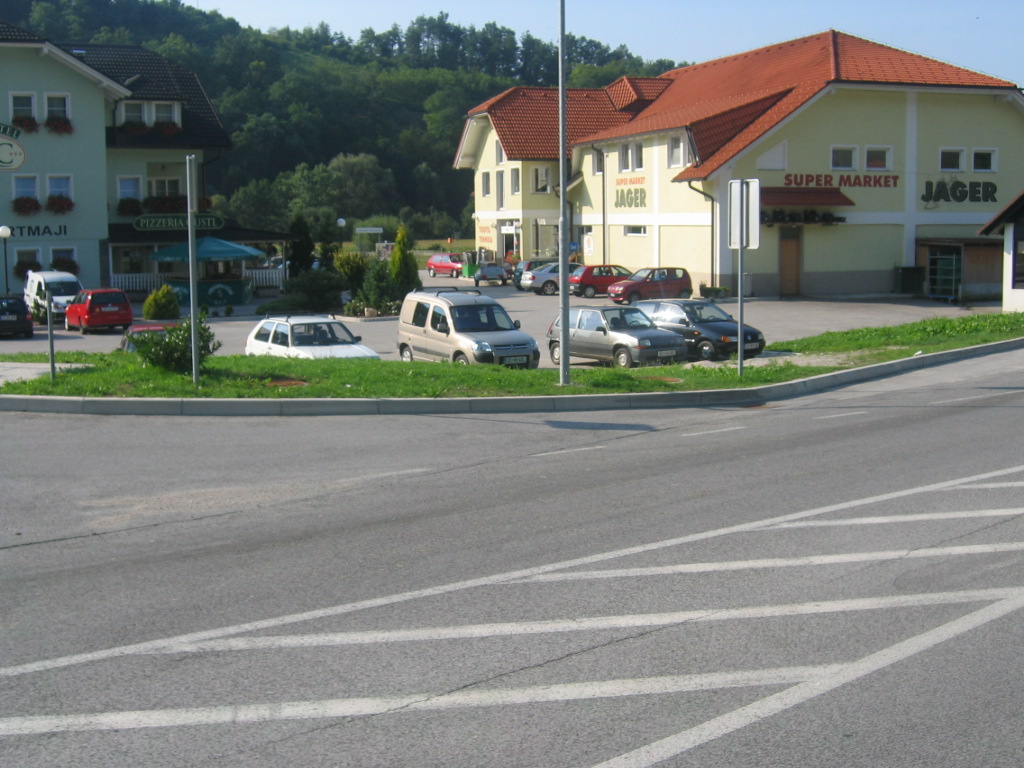
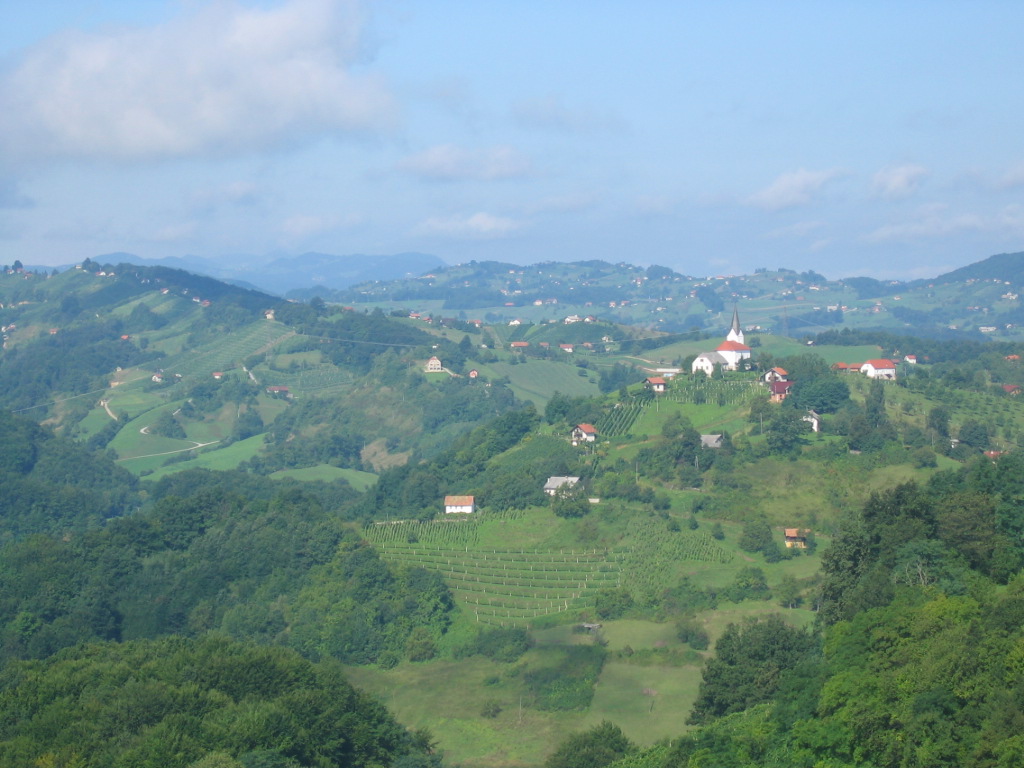
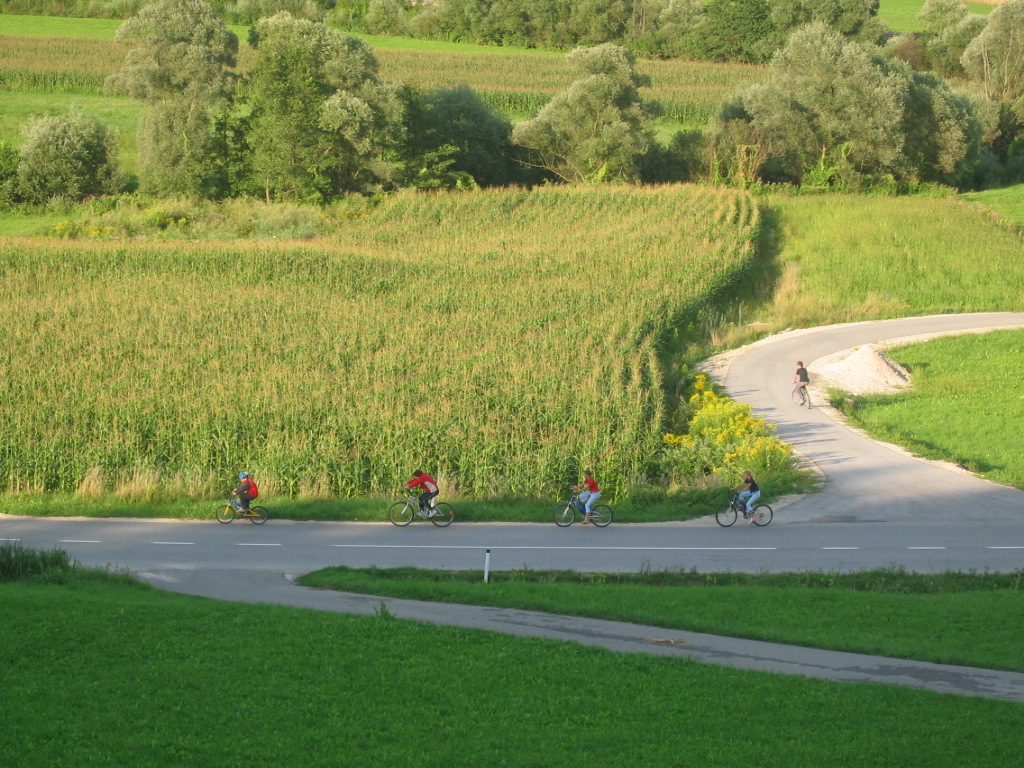
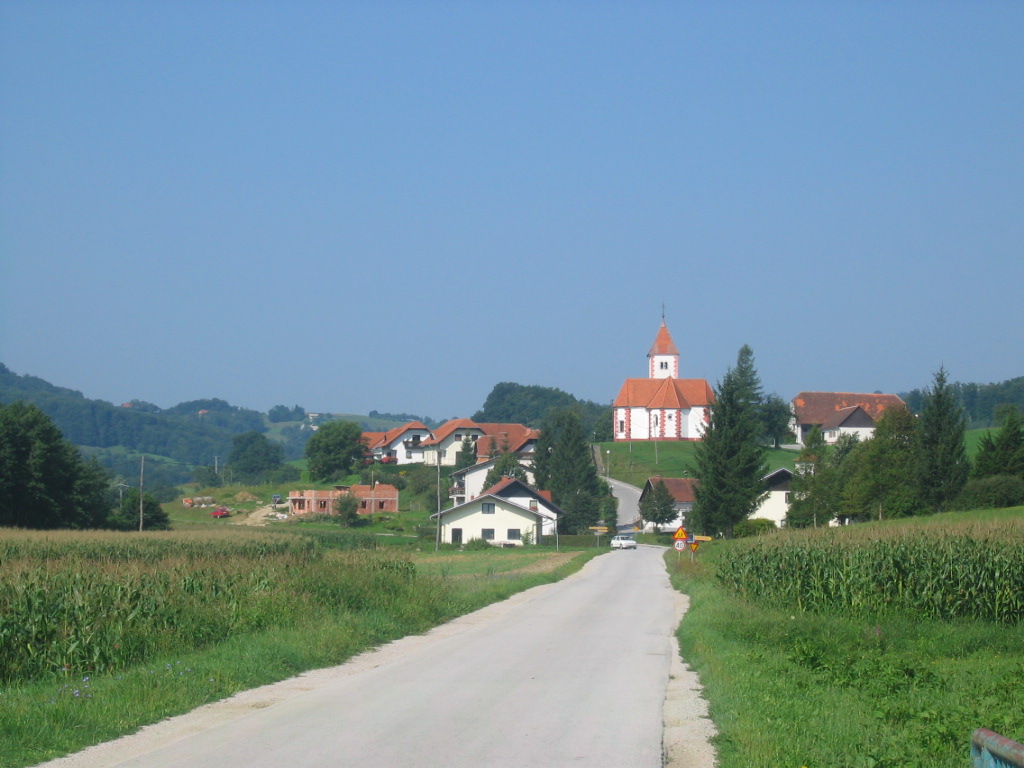
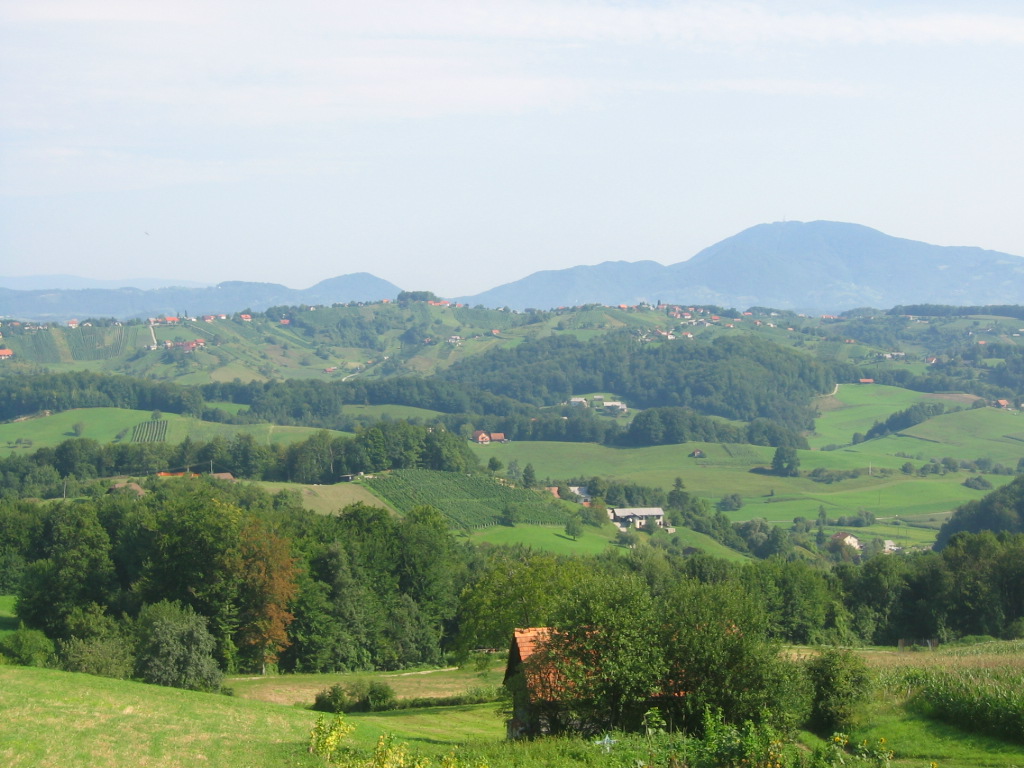
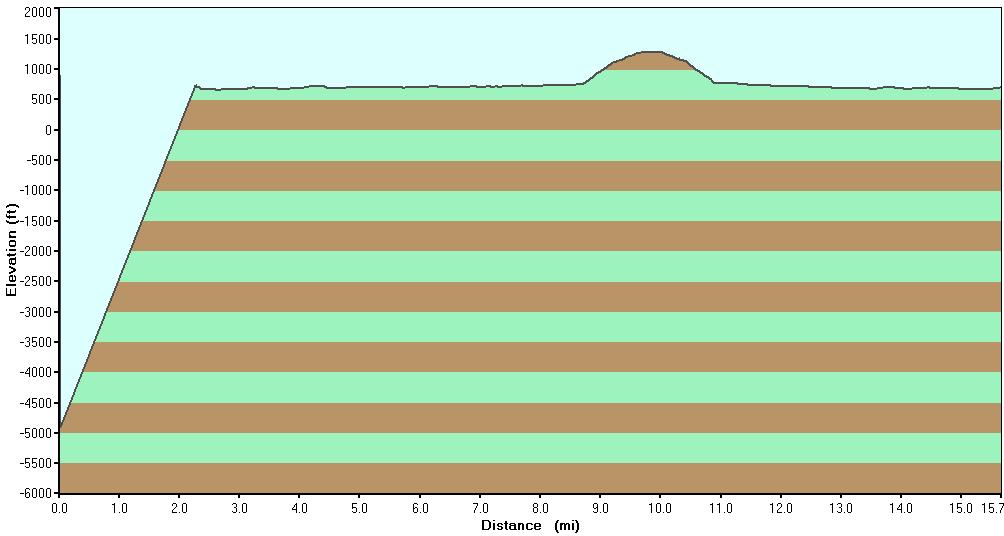
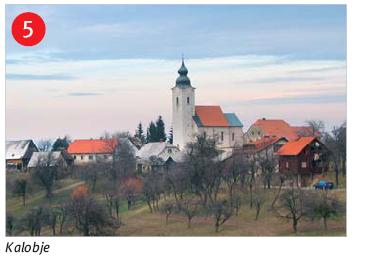
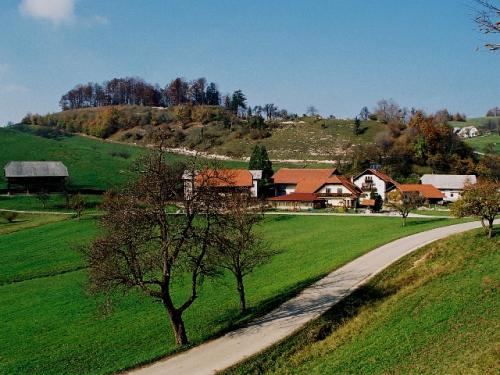
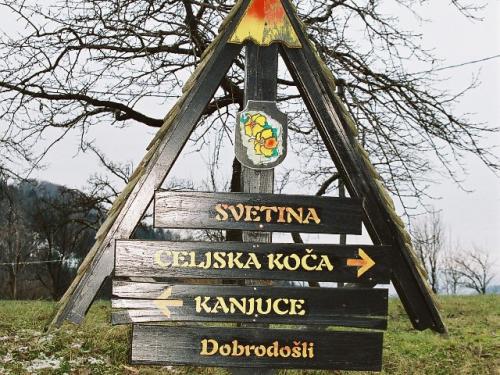
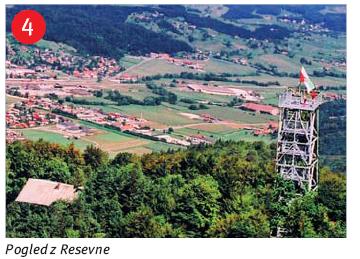
We ride past the pools along the main road into Sodna vas. At the junction we ride straight on to the bridge over the Mestinjščica, we continue the route past the railway station, where we carefully cross the line and arrive in Pristava. On the left-hand hill the church of St Urban can be seen, on the right-hand one the church of St. Emma. After 300m the road branches off towards Zibka; you turn left and once more cross the line and immediately after that once more left across the stream and we arrive in Zibka. This is a friendly little village below the Tinska gora. We continue the route to the next signpost, where we turn left for the village of Orehovec. Quite a hard climb awaits us; at the top we can rest a little, take a fine photograph or two and climb up the Tinska gora ( 409m). And then quite a long and steep descent awaits us so caution is not out of place. We descend into the valley and by way of Sodna vas return back to Podčetrtek.
Podčetrtek is an old settlement which was named in various ways. In the archives it was traced at the beginning of the 10th century. Its history is also testified to by the mighty Podčetrtek castle, which is a real regional and historical sight. Olimje Castle stands on gently sloping ground in the settlement of Olimje near Podčetrtek. Here a Gurk fief was already attested from 1208, but the manor as the centre of the estate is mentioned only in 1436. At the valuation of the property in 1542 a tower is mentioned – Turm zu Wollimel. The new mansion was built in 1500 (the date on the portal) by Hans Tattenbach. It had four wings, an inner arcaded courtyard and four round defensive towers at the corners. Today it is somewhat remodelled, while two wings with three towers are still preserved. In 1675 the church of the Virgin was added to it; in 1974 the church was severely damaged by an earthquake. In the castle is the 3rd oldest pharmacy in the world. When you visit Olimje you must not miss the other sights of the place. Beyond the Olimje monastery is Jelenov Greben, where deer graze on an enormous ranch. At a distance of 3 km from the market town of Olimje is the »Land of fairy tales and imagination«, where fairy-tale creatures live. The village of Olimje has three more interesting locations one is the Haler brewery and beer hall and the Agolf with the Amon inn. and domestic animals with an ostrich, and in the immediate vicinity of Olimje Castle stands the Syncerus Chocolate Boutique, in which you can treat yourself to something sweet.
The Church of St Urban stands on the Cmurek hill. It consists of a bell tower with an octagonal, pyramidal roof and a nave which is closed apsidally. The exterior of the church is simple, articulated with a base and a rod-profiled roof cornice. Among the interior furnishings belong: the high altar, made in the Baroque tradition, from around 1850, the painting of Pope Urban, which was made by Matevž Langus in 1850, and the early Baroque side altars, pendants from the beginning of the 18th century, dedicated to Thaddeus and John of Nepomuk. The pulpit is a simple work made in the Baroque tradition from around 1850. The church is first mentioned in 1684. From this period the bell tower is preserved, while the present nave was erected in place of the original one around 1850. The church design represents a more modest example of church architecture, while its dominant location gives it marked spatial significance.
You will ride past the Church of St Emma, which lies on the hill of the same name. The correctly oriented pilgrimage church consists of a prismatic bell tower with a pyramidal roof, a rectangular nave, a narrower and lower presbytery closed on three sides, two chapels and, on the northern side of the presbytery, a sacristy.
Tinska gora lies on a ridge that separates the valleys of the Zibika and the Tinje streams. Its summit is barely 409 metres above sea level, and yet enough for a view to open up to all sides of Styria as far as Pohorje and the Kamnik Alps. The name is said to derive from an old Slovenian word. It is supposed to have denoted an enclosure or an enclosed space. Some say that on the top of the hill, where today there are two churches, a small castle or grange once stood. The churches of St Anne and of the Mother of God stand on a steep hill, which on the sunny side is surrounded by vineyards. The first gives an impression of severity and seriousness, the second, Mary's, with its architectural appearance awakens liveliness at the sight of it. Stylistically they belong to the Gothic, although between them there is almost a hundred years' difference. The Gothic church of St Anne is the older. It was built at the end of the 14th century.