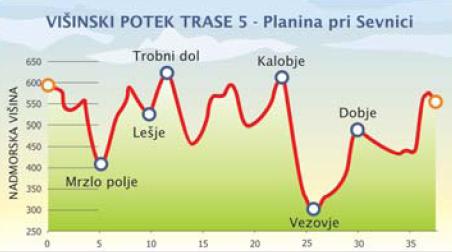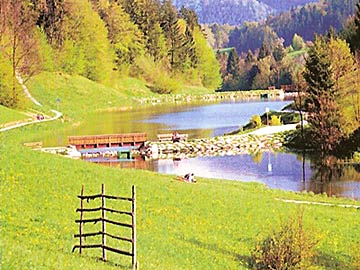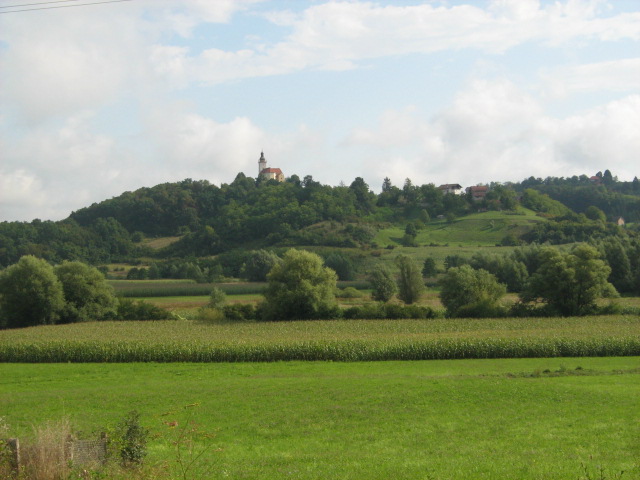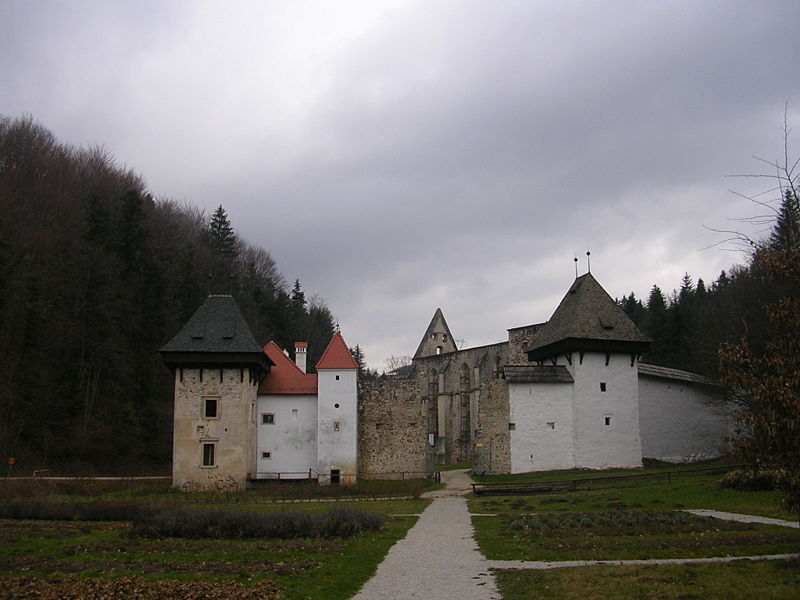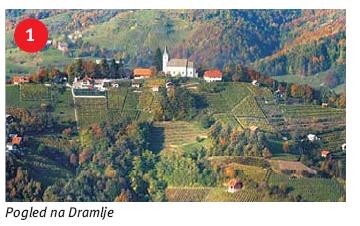




• Planina pri Sevnici: the medieval market square, Planina castle, the pillory, the Turkish lime tree, the Šmid Ethnological Collection, the birthplace of the writer Anna Wambrechtsammer, the Stations of the Cross chapels on nearby Sveti Križ
• Visoče: plague pillar
• Jurklošter: charterhouse
• Marof: fishponds, angling lodge
• Šentrupert: Church of St Rupert
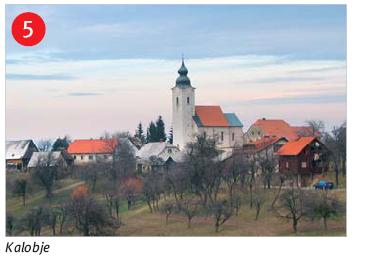
• Kalobje: pilgrimage church
• of the Name of Mary (viewpoint)
The village of Planina is located below the northern foot of Bohor in Kozjansko. It stands on a watershed pass in the headwaters of the Sevčnica, the Gračnica and the Dobje stream. Planina pri Sevnici is a crossroads of roads towards Šentjur, Rimske Toplice, Sevnica and Kozje. Above the village rise elevations: to the west Pečine, to the east Krampil and to the south-east a panoramic elevation with the pilgrimage church of the Holy Cross. Planina is first mentioned as a vineyard village, then as a market town, and finally as a market town with walls. In 1494 the Turks laid waste to Planina. In 1646 the plague at Planina and in its immediate surroundings claimed a thousand victims. In memory of this event they erected a stone pillar in Visoče.
Planina Castle was built on a rock above the market town of Planina. The ruins show Romanesque components in the core, while the southern castle wall is Gothic, and the entrance part and part of the curtain wall on the north-western side are Renaissance. The core of the castle was formed by a mighty palace, which was in its time 38 metres long and 15 wide. Besides the mighty curtain wall, which in its lower part measures as much as two and a half metres, the castle was protected on the western side by a defensive tower, which guarded the original southern approach. The lower part of the wall is in places even built in the form of a fish bone or an ear of grain (opus spicatum), which is a greater curiosity. The Turkish lime tree in Planina was planted behind the castle at the time when the Turks attacked Planina. In the battle the lords of Planina defeated them, and the Turkish commander was also killed. At the place where they buried him they planted a lime tree. Thus this lime is called the Turkish lime. The family doctor Dr Janez Šmid, during many years of service at Planina, created a collection of ethnological objects. Because of his interest in the folk heritage that was decaying before his eyes, he began to collect things belonging to this field. The collection consists of objects and tools which the people at Planina and in the surroundings used in the 19th and 20th centuries in everyday tasks, from the preparation of food in the black kitchen to other household chores. The collection also covers objects and tools which people used in farm work in arable farming, stock breeding, fruit growing, viticulture etc. objects illustrating carnival celebrations and other customs are also shown separately.
Marof is a hill above Novo mesto, across which runs the road connecting the town centre and Bršljin. On Marof there are extensive archaeological sites, where among other things the remains of Celtic situlae were found, which are kept in the Dolenjska Museum. Kalobje is first mentioned as early as 1278. On a stone built into the church it is written that the church was built in 1572. The Kalobje manuscript is an extensive handwritten book more than three hundred years old, with religious songs, mass bequests and a short catechism. It got its name from Kalobje, from where it came into the hands of Anton Martin Slomšek, probably from the hands or the estate of Mihael Zagajšek – the first parish priest there, who among other things prepared a dictionary, but managed to publish only a grammar written in Slovenian. Since he was interested in everything written in Slovenian, he also came by this handwritten collection bound into a book. The manuscript, however, did not originate at Kalobje, nor elsewhere in Styria; it is said to have originated somewhere in Lower Carniola in the period between the years 1640 and 1651.