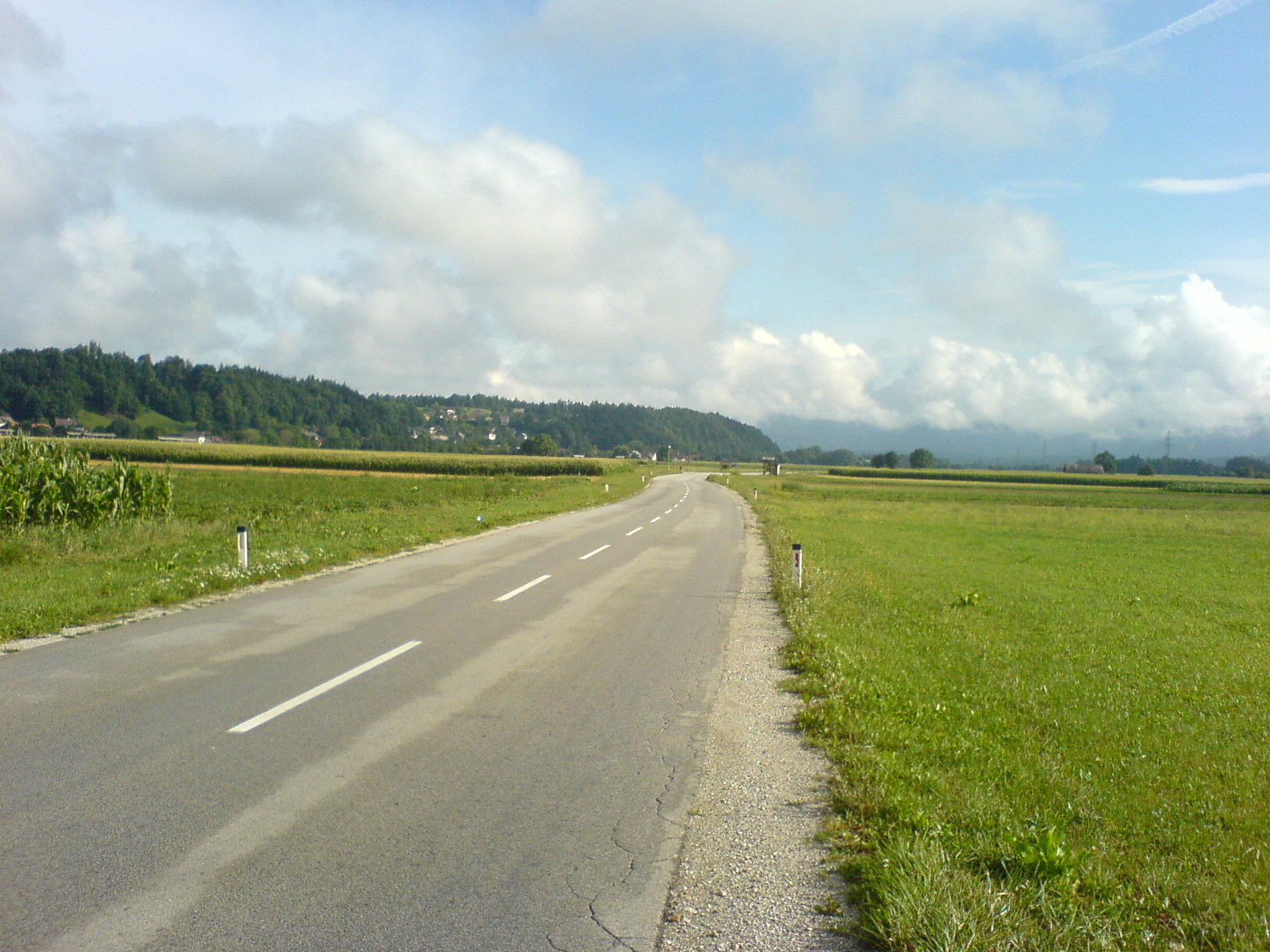
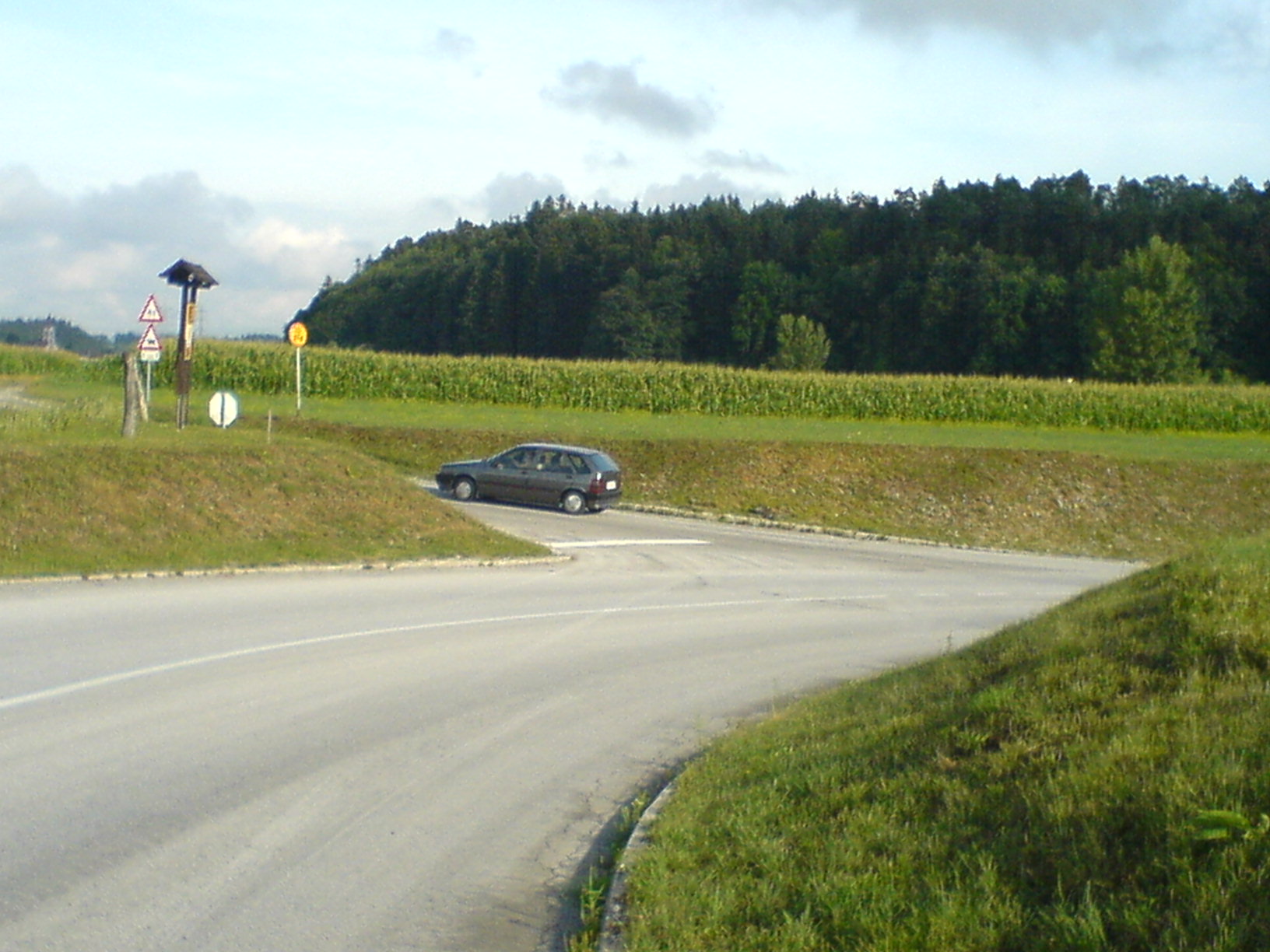
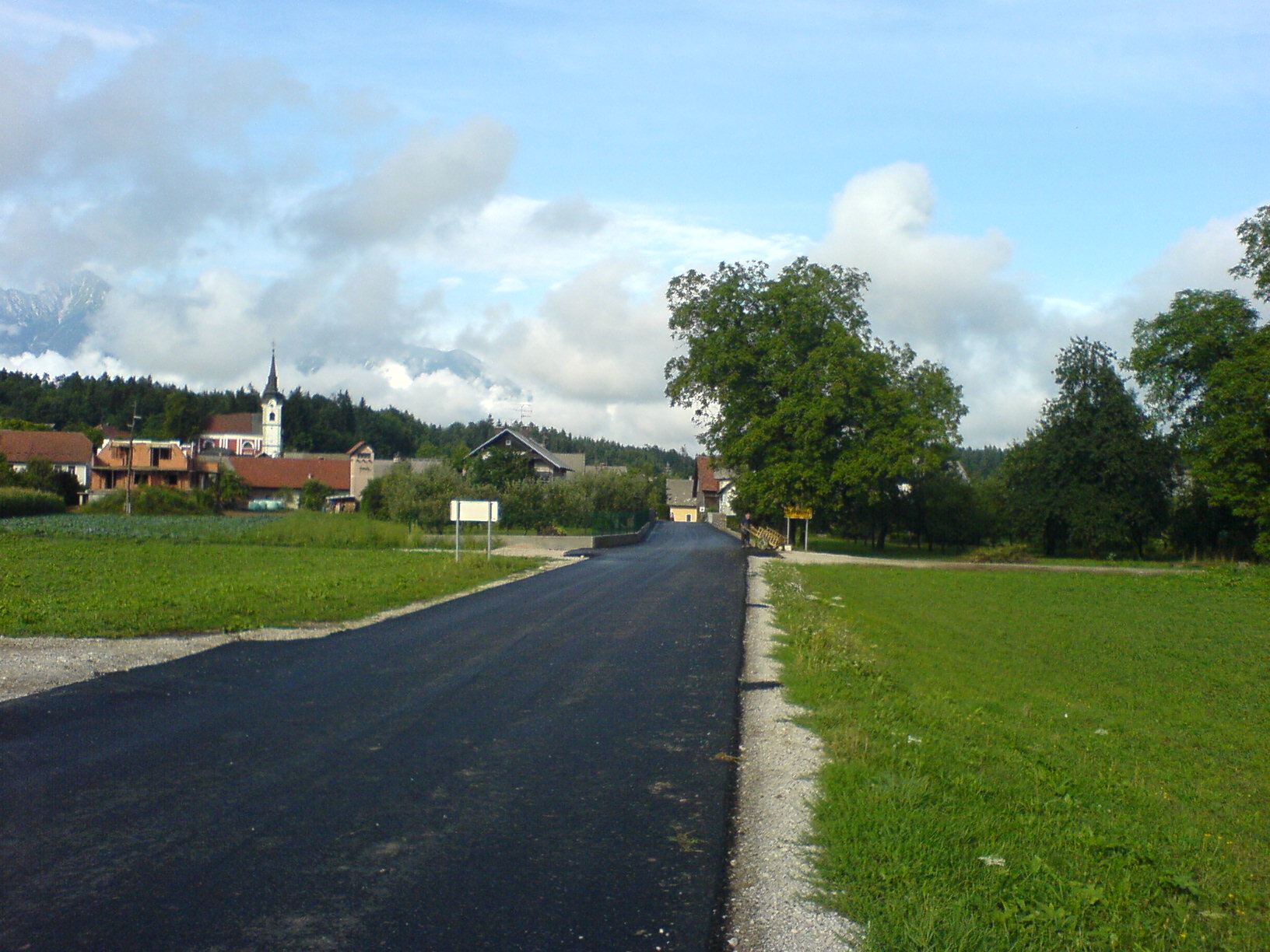
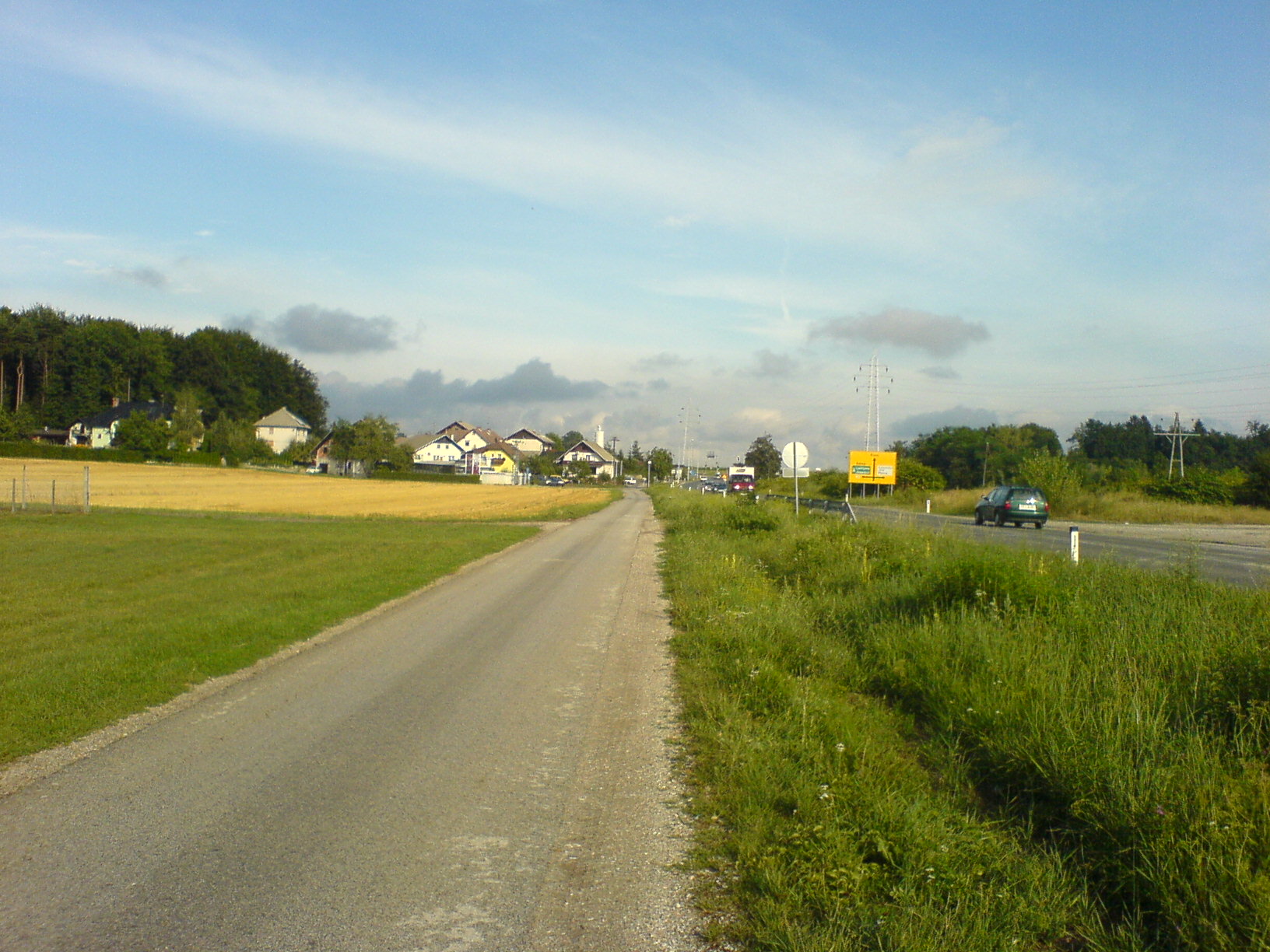
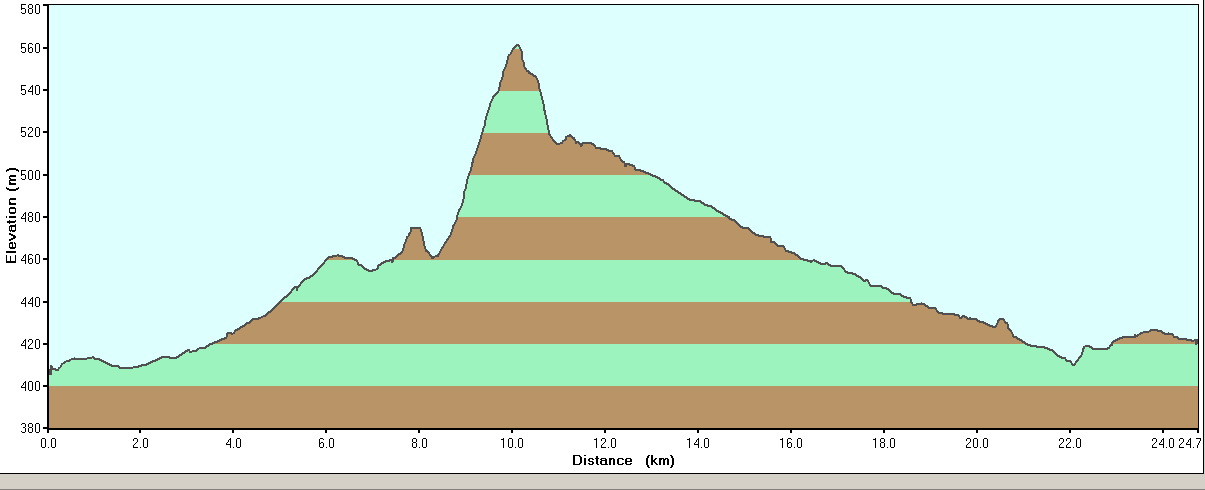
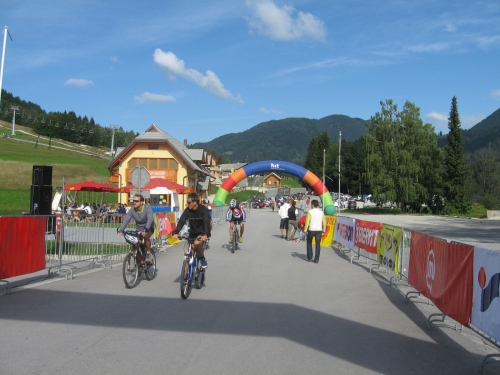
I began cycling at Kokrica by the Dežman inn, and continued past Mlaka towards Goriče. The road on this stretch is level. From Goriče we first descend slightly towards Golnik. From Golnik towards Križe, however, is the only climb where a little more energy has to be put in. When you get to Križe, turn left ( sign Kranj ) and after 300m turn left again ( sign Kranj ). Then follow the villages of Duplje, Žeje . At the end of the village of Žeje you will catch sight of the motorway on the right-hand side. A good kilometre out of the village of Žeje , before the motorway underpass turn left towards Strahinj. In the village of Strahinj turn right along the priority road and continue the route towards Naklo. You will ride past the pizzeriaBolero towards the main road, where you will turn left onto the arranged cycle path which runs beside the main road. When at Polica you come to the traffic lights, turn left towards Kokrica; if you go on, however, the route leads towards Kranj.
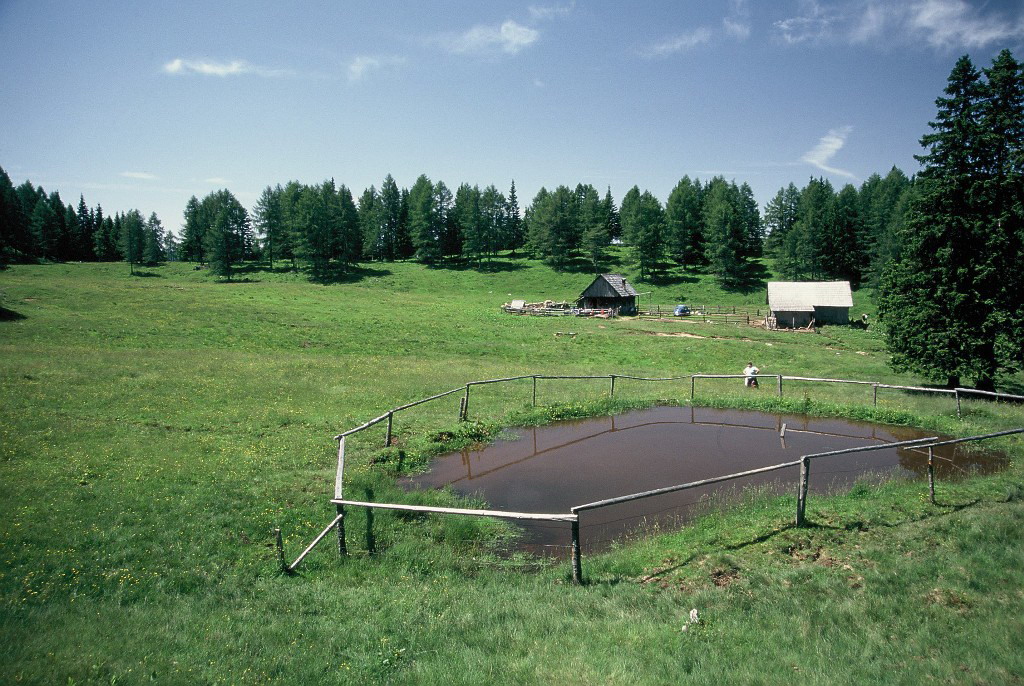
Kokrica lies on damp ground north of Kranj, at the crossroads of the roads leading to Golnik, to Naklo, Preddvor and Predoslje. The book History of the Town of Kranj mentions Kokrica as early as the 11th and 12th centuries, when the Patriarchs of Aquileia held ownership over it. In the 14th and 15th centuries Kokrica belonged to the Ortenburg estate. The settlement was originally called Kakericz and is of pre-Slavic origin, and means little Kokra. At Kokrica the Bobovek lakes are located. The natural feature of the little lakes at Bobovek covers the area around the three little Bobovek lakes: Čukova jama, Krokodilnica and Ledvička. During the First World War a brickworks began operating at Bobovek, and its owner was the local man Zabret, known as Čuk. The pit which came into being then through the digging of clay is for that reason still called Čukova jama today. After the Second World War a second pit was dug, to which, however, the curious name Krokodilnica stuck, even though there were never any crocodiles in the vicinity. Along these banks children in the past liked to ˝slide down on their bums˝ and because they had green trousers, they were told they were as green as crocodiles. Hence too the name Krokodilnica. A thirteen-metre excavation into the depths opened up an interesting view into a past some three hundred thousand years old. According to all the data obtained, there is said to have been a lake here many years ago. This is confirmed by the excavation of the fossil remains of a shoal of dace at a depth of 8 m. They are said to be around 180000 years old. Very interesting, however, is certainly the find of the remains of a mammoth skeleton at a depth of 8.5 m below the surface. From the weaker bones they conclude that it was a female, and from the wear of the molars they conclude that at death it had passed forty years of age. It probably strayed into the marsh and sank there, or else it was driven there by Ice Age hunters, who probably lived here in the vicinity. A few years after the war the brickworks was nationalised, and in 1971 it ceased operating, since the digging was halted by groundwater at the level of the Kokrica stream. The excavated pits were thus flooded with water, and because of the clay the water also remained in them. Three little lakes came into being. Apart from everything listed, the clay is also worth mentioning. The clay which is found in the lakes is medicinal, since it is mentioned in his books by the well-known herbalist and Father Simon Ašič. The clay helps with virtually all ailments (fracture, trouble with teeth, corns, burns, suppurating wounds, it cleanses the organs of the urinary tract etc.). Many villagers have already tested the healing power of the clay on themselves, and laboratory examinations have also scientifically confirmed the healing power.
Goriče is a roadside central settlement with a clustered core and lies 2 km south of Golnik. The parish church of St Andrew is first mentioned in 1376. The present building with its furnishings dates from 1852. The high altar is the work of the Kranj sculptor Janez Stimmer (1753 – 1835) from 1792. In 1852 the altar was moved from the Kranj parish church.
When you ride towards Golnik you will pass through the village of Tenetiše. To the north-west of the village of Tenetiše is the well-known »Klemenček hill fort«. It stands on the higher eastern edge of the Udin boršt forest above the meander of the little river Parovnica. The »Klemenček hill fort« is a temporarily arranged shelter or refuge from the late Roman period (5th to 6th cent. AD). The central plateau is surrounded by defensive ditches and earth ramparts. Well known, however, is the story of the origin of the name Tenetiše. In the village many years ago building a church with the most beautiful bells. Since in those times they did not know modern machines, the bells had to be transported by carters. The roads to the village at that time led across a marshy forest. When they were driving across the forest, on account of the overloaded carts they got bogged down in the mud. Since the horses did not have enough strength to pull the cart out of the mud, the carter Tone shouted to his farmhand Tine : "Tine tiš!" Thus the small village on the road to Golnik got its name after the farmhand Tine : Tenetiše.
At Tenetiše you can also turn off to the village of Trstenik, where the parish church of St Martin stands. On the site of the old church they built a new church in the years 1869 – 1871. They preserved only the Baroque bell tower from 1703. Three altars and the painting in the main altar are the work of Jurij Tavčar. Only three kilometres separate us from Bašelj, where the road to the villages of Povlje and Babni vrt branches off and from where a view of Kranj and the Kranj plain opens up to us.
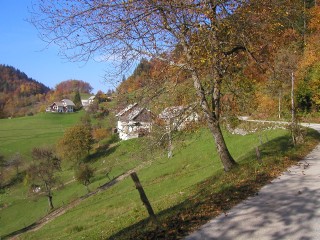
Golnik is a village at the foot of Kriška gora in Upper Carniola, which developed at the same time as the development of the sanatorium in the twenties of the last century. Before that there was a castle here, which is waiting for renovation and is first mentioned as early as 1566. The first lords – owners were the Križ lords. The castle is called Kreutzhof after its owner Jurij Kreutzer. Later the castle received the name "Gallenfels", because from 1688 to 1822 it was in the hands of owners with that name. In 1917 it passed into the ownership of the Austro-Hungarian state. At the same time the state proclaimed Golnik a sanatorium for returning sick soldiers.
Valvasor also mentions and depicts in a copper engraving the castle "Gallenfels", although he himself says that he cannot establish the origin of the name Glavnik. The Golnik manor is located in Upper Carniola at the southern foot of the mountain ridge of Kriška gora, about 1600 m high. The healing climatic conditions, especially the favourable humidity and much sunshine, already in 1916 brought the Austro-Hungarian government to choose the place of Golnik for a climatic sanatorium for lung patients.
In Sp. Duplje stands a manor which was built on this site as early as the 13th century by the knights of Duplje. Over the centuries it changed owner several times. Valvasor's copperplate engraving of the manor, from the 17th century, has been preserved in it. In 1759 the last important owner died, and at that time all the rooms were inventoried, thus leaving a document of how it was built.
The church of St Nicholas na Brdu in Strahinj was built around the year 1382 on a small rocky elevation. It is dedicated to St Nicholas – in local speech St Miklavž. Around the church there was once a cemetery. The present one they built in 1769. St Nicholas in the main altar was painted by Karel Götzl from Kranj. The greatest sight of the church is certainly represented by the fresco in the space below the bell tower. It came about in the 14th century and has great historical value.
In the middle of the village of Naklo stands the church dedicated to the patron St Peter. It is single-naved and built in the shape of a Latin cross and is thus a fine example of Baroque building.In it we can admire quite a few exceptional works of art. The high altar and the statue of St Peter are the work of Jospi Götzl, while the altar painting Jesus hands the keys to St Peter was painted by the famous painter Leopold Layer, who also created the painting of the Virgin at Brezje. The church also takes pride in an exceptionally fine Way of the Cross, which is the work of the artists Josip Wolf and Jan Vurnik. The church of St Nicholas at Brdo in Strahunj was built around the year 1382 on a small rocky rise. It is dedicated to St Nicholas – in the local speech St Miklavž. Around the church there was once a cemetery. The greatest attraction of the church is the fresco in the space beneath the bell tower. It came into being in the 14th century and has great historical value.
Polica is located on a terrace between Kranj and Pivka. The terrace is part of Udin boršt, which in the Temnik gorge comes closest to Dobrava. Through this gorge in 1908 they laid the railway towards Tržič, while today the tracks end already in Naklo. Out of the conglomerate rock the Puhar family carved millstones at Polica for more than 300 years. At Polica today there is the junction onto the Ljubljana – Jesenice motorway. Today it is known for the folk artist and sculptor Janez Vovk and for Anton Grašič, a world-famous collector of antiques. At Polica you can stop at the Poličar family farm, where you will get all kinds of farm produce, while at the neighbouring Pr’ Škofče farm they will teach you to ride horses.