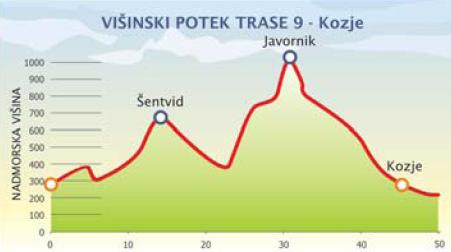
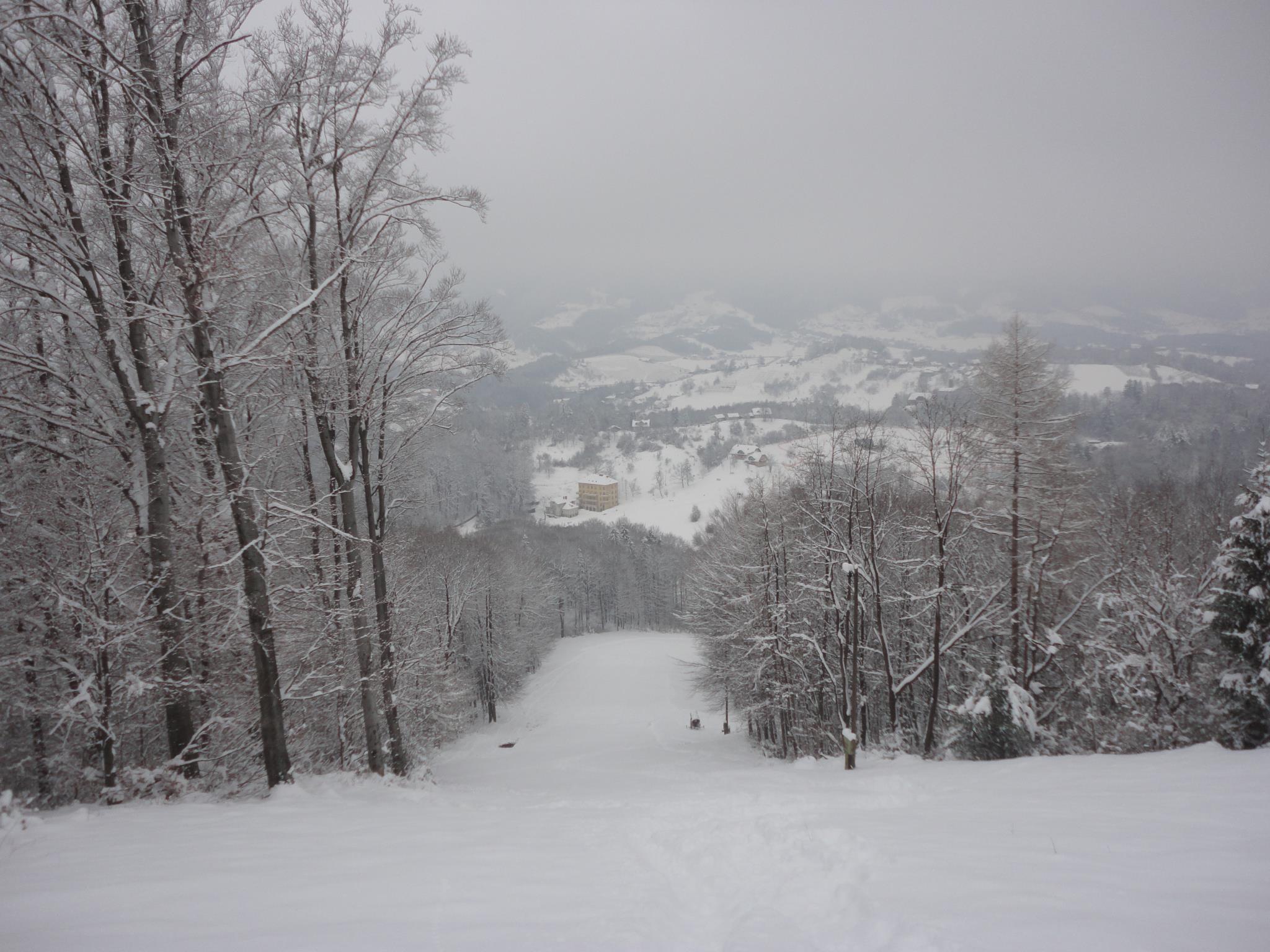
Kozje – Pilštanj – Lesično – Šentvid pri Planini – Planina pri Sevnici – Zabukovje nad Sevnico – Mrzla planina – Zalog – Bistri Graben – Kozje
• Kozje: the old market-town core, Kozje manor, the ruins of Kozje Castle, a pond
• Pilštanj: the medieval market square, the pillory, the Ajdovska žena rock monolith, well-kept footpaths
• Zagorje: the pilgrimage church of Our Lady
• Šentvid: Church of St Vitus
• the Sevnična gorge: a preserved river valley
• Bohor: a mountain hut, a habitat of the jarica flower, Vilna peč, the Bistri Graben gorge, preserved natural landscape
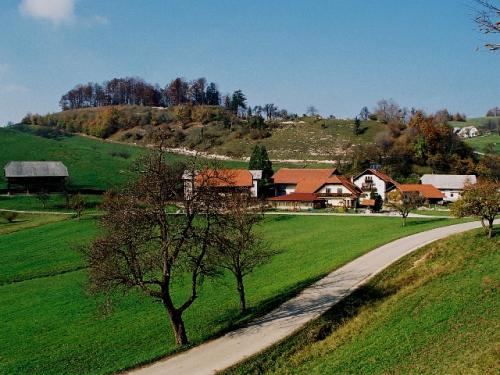
The area of Kozje has many natural and cultural monuments: the plane tree in front of the manor in Kozje, the parish church of the Assumption of Mary, the branch church of St Emma, the Ajhker (granary) and a hayrack with a barn,…
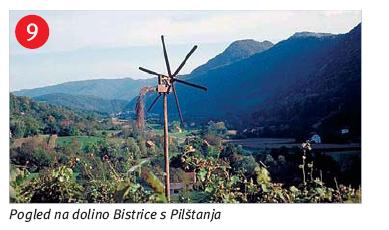
Pilštanj is a dispersed settlement on the western edge of the Kozjansko hills in the Municipality of Kozje. The market town of Pilštanj took shape between two summits; on one of them stood the Pilštanj castle (Peilenstein), which is first mentioned in 964. On the other elevation the Dren castle (Hartenstein) came about. Today both are in ruins. In the time of the Turkish incursions there was in Pilštanj a signalling station, which warned of danger with beacon fires. The market town of Pilštanj is first mentioned in 1404 and has a ground plan layout with a rectangular market space. The parish church of St Michael is first mentioned in 1167. Below the settlement, on the steep slope above the Bistrica, several rock hermits came about because of the washing away of softer rocks. The largest, the Pagan Woman, has the shape of a woman with a child in her lap.
The village of Planina is located below the northern foot of Bohor in Kozjansko. It stands on a watershed pass in the headwaters of the Sevčnica, the Gračnica and the Dobje stream. Planina pri Sevnici is a crossroads of roads towards Šentjur, Rimske Toplice, Sevnica and Kozje. Above the village rise elevations: to the west Pečine, to the east Krampil and to the south-east a panoramic elevation with the pilgrimage church of the Holy Cross. Planina is first mentioned as a vineyard village, then as a market town, and finally as a market town with walls. In 1494 the Turks laid waste to Planina. In 1646 the plague at Planina and in its immediate surroundings claimed a thousand victims. In memory of this event they erected a stone pillar in Visoče.
Planina Castle was built on a rock above the market town of Planina. The ruins show Romanesque components in the core, while the southern castle wall is Gothic, and the entrance part and part of the curtain wall on the north-western side are Renaissance. The core of the castle was formed by a mighty palace, which was in its time 38 metres long and 15 wide. Besides the mighty curtain wall, which in its lower part measures as much as two and a half metres, the castle was protected on the western side by a defensive tower, which guarded the original southern approach. The lower part of the wall is in places even built in the form of a fish bone or an ear of grain (opus spicatum), which is a greater curiosity. The Turkish lime tree in Planina was planted behind the castle at the time when the Turks attacked Planina. In the battle the lords of Planina defeated them, and the Turkish commander was also killed. At the place where they buried him they planted a lime tree. Thus this lime is called the Turkish lime. The family doctor Dr Janez Šmid, during many years of service at Planina, created a collection of ethnological objects. Because of his interest in the folk heritage that was decaying before his eyes, he began to collect things belonging to this field. The collection consists of objects and tools which the people at Planina and in the surroundings used in the 19th and 20th centuries in everyday tasks, from the preparation of food in the black kitchen to other household chores. The collection also covers objects and tools which people used in farm work in arable farming, stock breeding, fruit growing, viticulture etc. objects illustrating carnival celebrations and other customs are also shown separately.