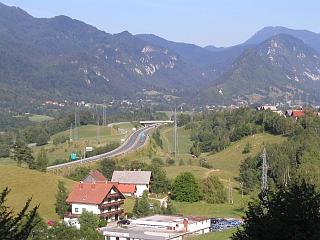
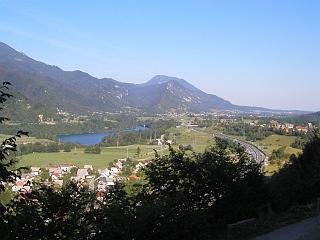
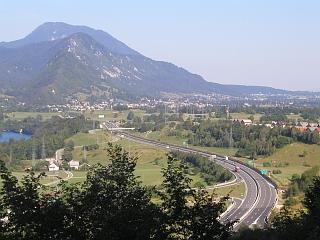
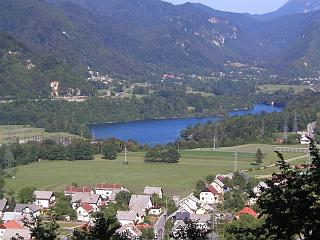
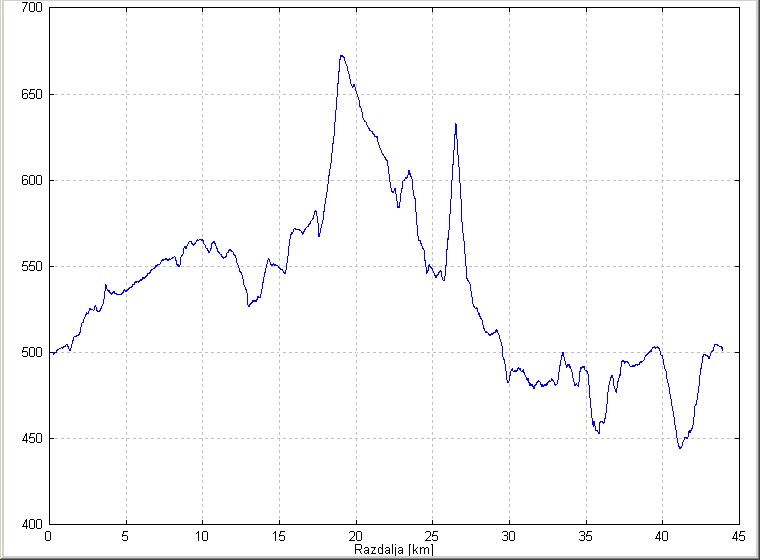
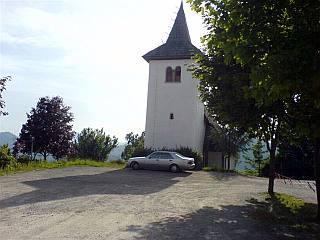
In the centre of Lesce we turn towards Hraše. At the end of Hraše the road for Studenčice branches off to the left, but we continue through the narrow part towards Rodine. We continue left in the direction of Žirovnica. After crossing the railway line we continue straight on through Moste and on towards Jesenice. At the first traffic-light junction at Slovenski Javornik we turn left. The narrow road, after a few bends, ends at a junction, where we turn left and then left once more. When we cross the Sava Dolinka, we continue left in the direction of Bled. At the bus stop we turn left and through Lipce, across the motorway and Blejska Dobrava we return to the road towards Bled. After a shorter climb we come to Kočna. We continue to Spodnje Gorje, where we cross the Radovna River. At the turning for Vintgar we turn left, and at the next junction we go straight on through Podhom. At the junction after the railway bridge we turn left towards Zasip. At the junction where the main road turns right towards Bled, we turn left. Along a narrow road between the houses we climb steeply to the church of St Catherine, where there is a fine view over Gorenjska. We return to the junction and continue straight on towards Bled. From the main road in Bled we turn right at the bus station, ride along the lake below the castle, through Zaka to Mlino. There we turn right towards Selo and ride straight on through Selo. At the junction of several roads we continue in the direction of Bodešče. Soon we turn left onto a narrow asphalt short cut to Koritno. In Koritno we turn left for Bled. At the petrol station we turn right towards Lesce. When we cross the Sava, we can soon switch right onto the cycle path to Lesce.
From Lesce you can fly over Upper Carniola. In Lesce there is an airfield where it is possible to fly over the places of Upper Carniola.
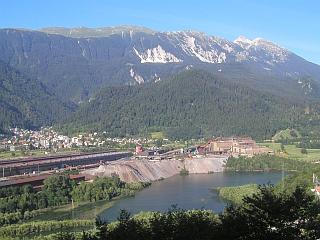
Lake Bled, which came into being with the retreat of the Bohinj glacier and is 2120 long, 1380 wide and 30.6m deep, Bled Island with the church of the Assumption of Mary and 99 steps, Bled Castle on the rock, the cave below Babji zob, the Parish church, the monument to Josip Plemelj and France Prešeren, the Grimšče manor, the pletna oarsmen and the coachmen are part of the beauty of Bled that must be seen. The filial church of the Assumption of Mary and St Roch on the Sava belongs to the complex of the urbanistically protected centre of Stara Sava in Jesenice. It was built at the beginning of the 17th century. It represents the first example of Jesuit architecture in Slovenia; its exterior is Gothic, while the furnishing of the interior is of later origin. Stara Sava is an old ironworking and residential settlement which once gave the town its pulse and today is protected as a technical monument. The core of the former settlement is made up of the Bucellini-Ruard manor , the church of the Assumption of Mary , the workers' residential building called "Kasarna", the remains of the ironworks plants and the restored blast-furnace chimney and the mill.
The manor was built in the first half of the 16th century by the Italian Bernardo Bucellini. In 1831 it was enlarged and renovated in the Classicist style. In the building, since 1954, there has been the Technical Museum of the Jesenice Ironworks. Today the seat of the Jesenice Museum with an exhibition on the history of ironworking in Upper Carniola is in it. The Kos manor belongs to the group of four ironworks castles which the owners of the ironworking plants built in the 16th and the first half of the 17th century at Sava, Plavž, Murova and Javornik.
The ironworking manor at Murova was built in 1521, and in the sources it is mentioned as the "old Bela Peč castle". It underwent numerous rebuildings and changed even more numerous owners. At the beginning of the 19th century the merchant Pavel Kos became its owner. It is also named after him "the Kos manor. Today it houses rooms intended for temporary exhibitions and a permanent collection of more recent history, while on the second floor there are a wedding hall and a protocol municipal room, which often hosts cultural events. On the ground floor visitors can view a reconstructed prison cell. The Sava mines are still today proof that in these parts a mining tradition was deeply rooted which survived almost eight hundred years, since the beginnings of ore digging reach back to the year 1130, right up to 1907, when mining died out completely. It is known that even the manorial dues were in iron. The blast furnace at Stara Sava was in the middle of the 19th century the property of Viktor Ruard and was the mightiest among the Jesenice blast furnaces. It was 38 feet (12 m) high and measured 9 feet (2.8 m) in diameter. It was operated by 16 furnacemen. Daily they obtained from it 200 Viennese hundredweight of pig iron. This they poured into special moulds, where it hardened. Because of its shape the pig iron from the moulds was called "štruce".
The Municipality of Žirovnica is full of cultural monuments. You can visit the homestead of Matija Čop, of Anton Janša (the first Slovenian beekeeper), to whom the beekeeping museum in Radovljica is also dedicated, the Parish church, the Church of St Martin, the Church of St Radegund, the Church of St Clement, in Vrba the homestead of France Prešeren,… Near Gorje, approximately 4 km north-west of Bled, Jakob Žumer, the Gorje mayor, and the cartographer and photographer Benedikt Lergetporer discovered the Vintgar gorge in February 1891.
The Vintgar gorge, 1.6 km long, is cut between the vertical walls of the hills Hom and Boršt, and it is adorned by the Radovna with waterfalls, pools and rapids. The path leads over bridges and the so-called Žumer galleries and ends with a bridge above the mighty 16 m high river waterfall Šum. Because of its natural beauties the Vintgar has been ranked among the more important tourist attractions of Slovenia, and the number of visitors grows from year to year. In one direction of the visit to the gorge you can make use of the possibility of the “panoramic footpath” across Hom to St Catherine (a historic little church and a beautiful view). At the entrance and at the Šum waterfall you can take refreshment in the buffets.
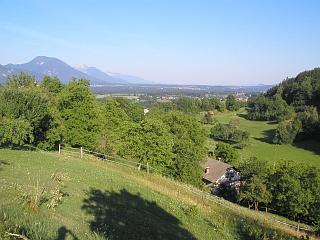
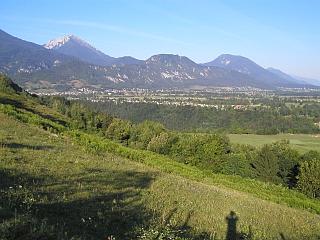
Zasip lies 2 km north of Bled on the southern, sunny slope of Hom. France Prešeren, the greatest Slovenian poet, named Zasip "the altar of Gorenjska", since from here, or better still from Hom, the hill above the village, we can enjoy a wonderful view. On Hom stands the little church of St Catherine, which has a rather interesting history. In the 15th century Pope Alexander VI confirmed the confraternity of St Catherine, out of which a pilgrimage developed. It is interesting that under the threshold of the little church a treasure was hidden. During the retreat of Napoleon's army from Russia a certain French general buried a military chest at this spot, in which there were money and jewels for the French soldiers paid at that time. During the fighting in northern Italy the general was mortally wounded, and he confided the secret to a friend, and the latter, with the help of two locals, dug up this treasure.