High above the Bača valley, on the northern slope of the 1303 m high Kojca, lies the village of Zakojca (710 m) – the birthplace of the writer France Bevk (1890–1970). Zakojca can be reached both from the Bača valley (Grahovo, Hudajužna) and from the Cerkno area. The shorter and steeper road is led from the Idrijca valley (Reka) over Bukovo, while the longer "panoramic route" leads from the Cerkno area towards Porezen and then through the picturesque Cerkno villages.
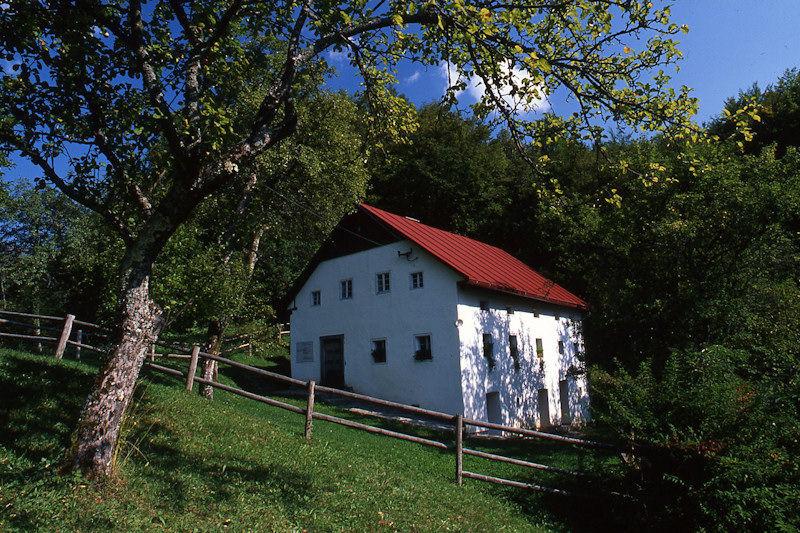
The Volar homestead (Zakojca 10), in which the writer France Bevk spent his childhood and early youth, stands on the slope below the village. For visitors it was ceremonially opened in 1990 on the 100th anniversary of the writer's birth. In the house there are several authentically presented rooms. On the cellar level there is a small byre for one or two cows and a couple of goats. On the ground floor there are first the hall and the kitchen with an open hearth and a built-in pig cauldron. The central living space is of course the "house", where the family gathered over food and especially during the long winter evenings. The space was heated by a bread oven, while a modest shoemaker's corner with a little table, two three-legged stools and tools testifies that Bevk's father also worked as a shoemaker there. Next to it is the chamber in which the parents and the youngest of the children slept, and then another chamber for the grandfather and grandmother. After their death this became France's room. Into the corner between the last chamber and the kitchen a barn for fodder, bedding and tools is also squeezed.
Old steep stairs still lead to the attic, only there is no longer the attic room there where Bevk as a twelve-year-old boy wrote and illustrated his first book. The attic has been converted into a large exhibition space, where the writer's life and work are presented with documents, photographs, books and objects. France Bevk is presented as a writer, publicist, and political and cultural worker. On the gable entrance façade a memorial plaque is fixed, which was erected to the writer as early as 1977 by the Club of Old Gorica Students.
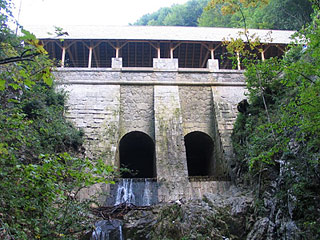
The pumping of mine water occupies an extremely important place in mining and in technology in general. Since the mine constantly followed the top achievements of technology, within the framework of the far-reaching modernisation of the mine after nationalisation at the end of the 16th century the Idrijca River above Wild Lake was dammed and a 3.5 km long channel was made, called the Rake, to drive the kamšt in the centre of Idrija. The preserved kamšt – a water-driven pump for pumping mine water (Ger. Wasserkunst) dates from the times of the mine's exceptional prosperity at the end of the 18th century, when they began to excavate Joseph's shaft. The kamšt was erected in 1790 and operated until 1948.
In the masonry building the drive water wheel is installed, an overshot bucket wheel with a diameter of 13.6 m, which is renowned as the largest preserved wooden water wheel of its kind in Europe. The rotation of the shaft of the drive wheel was transmitted through a crank, a connecting rod and horizontal drive rodding 75 m long, by way of two three-armed levers, to the pumping rods. The pumping was carried out in three stages, the piston pumps were installed on the XI, IX and III levels, of which one is on display. The drive water wheel turned 4-5 times a minute, the capacity of the pumps was around 300 litres of mine water a minute from a depth of 283 m below the surface. This is the only pump of its kind in Slovenia that stands in its original place. The weir on the Idrijca River at Kobila and the 400-year-old Rake channel still serve today to supply drive water to the Mesto hydroelectric power station.
Mine locomotives
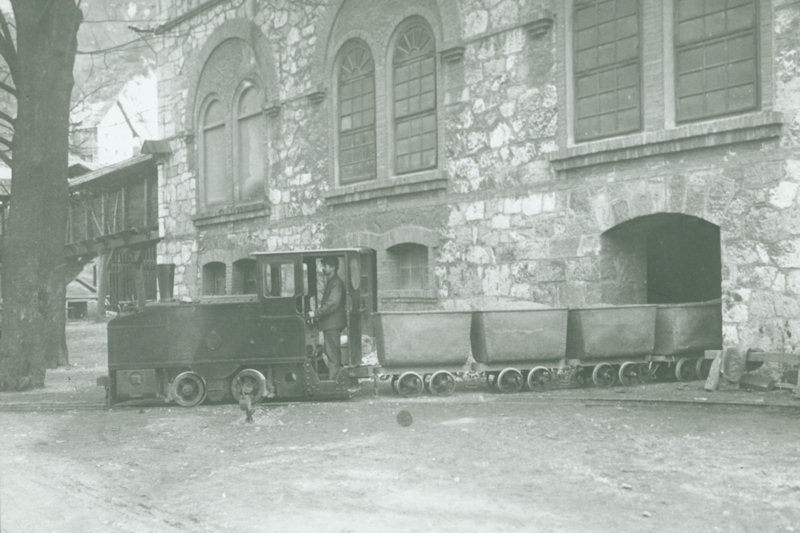
In the former cable-car loading station of the Jožef shaft, four locomotives and five ore transport wagons are on display.
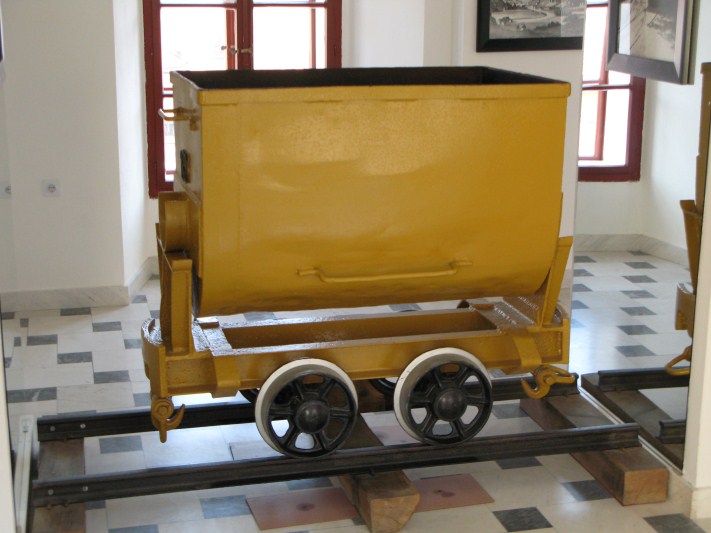
In the middle of the 19th century (around 1850) the Idrija mine built a horse-drawn railway for transporting ore from the shafts to the roasting plant. For transporting fine ore large wooden freight wagons were used, also called horse wagons. Just such a wagon has been preserved and is the oldest preserved railway wagon of a horse-drawn railway in Slovenia.
With the invention of devices for changing voltage the development of electric street railways was made possible. For a good half-century the mine railway gave shape to Idrija's streets and to the then sparse road traffic. In order to replace the horse team, in 1902 two electric locomotives from the Siemens&Halske Vienna factory were purchased for transporting ore from Joseph's shaft to the Bašerija (ore grading and crushing plant). For transporting ore from the Bašerija to the roasting plant, likewise in 1902, two more large electric locomotives from the Siemens&Halske Vienna factory were purchased for a track of 1000 mm gauge. The length of the electric locomotive line from the bunkers of Joseph's shaft to the Bašerija was 700 m, and from there to the roasting plant 850 m, so 1550 m in all. Both locomotives are the oldest preserved electric locomotives in Slovenia.
For transporting ore in the roasting plant (smeltery) the mine acquired in 1912 two petrol locomotives from the Deutz Werke factory for a track gauge of 500 mm. In 1916 they bought one more locomotive from the same manufacturer, which has been preserved to this day.
On 31 January 1957 the last transport of ore with the large electric locomotive was carried out. As early as the following day a cable car began operating from the new loading station to the separation and crushing plant above the smeltery, 1100 m long.
Location
Vodnikova, 5280 Idrija
Open:
every day: 9.00–16.00 accompanied by a guide from the Idrija Municipal Museum
Information and group bookings:
tel.: +386 5 37 26 600
fax: +386 5 37 73 580
e-mail: tajnistvo@muzej-idrija-cerkno.si
Admission / person:
adults – 3,00 €
young people (primary pupils, secondary pupils, students) – 2.00 €

The Frančiška Shaft
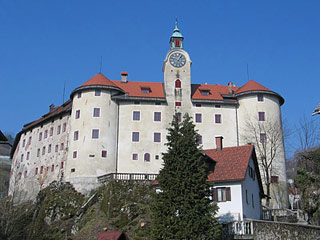
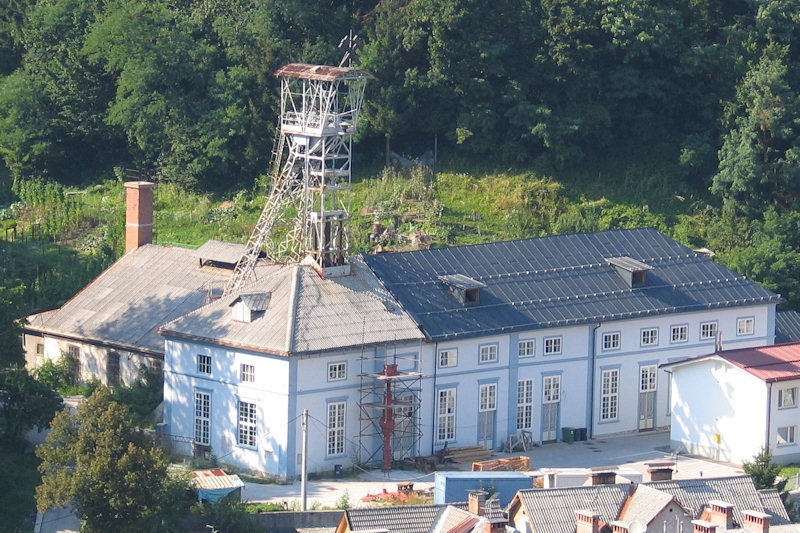
In the period up to the end of the 1950s the mine withdrew numerous machines and devices from operation. Precious examples of the mine's technical heritage were on view to visitors for three decades in the courtyard of Gewerkenegg Castle. Placed in the open, they were unfortunately exposed to all kinds of weather conditions, and at the beginning of the renovation of the castle in 1988 and of the castle courtyard two years later they were already in a very poor state. Among museum and other experts the decision matured that the machines had to be thoroughly and permanently protected, namely in an authentic mining setting. In three interior exhibition spaces and beside the building of the Frančiška shaft (after Francis II, who from 1792 to 1806 was Holy Roman Emperor, and then as Francis I ascended the Austrian throne) 29 exhibits are today displayed, mostly from the end of the 19th and the beginning of the 20th century.
These are four centrifugal pumps, a diesel engine and three compressors from the beginning of the 20th century, two winches, two steam piston engines from the end of the 19th century, three feed pumps for steam boilers, a hoisting machine with steam drive, a steam boiler and a Francis water turbine from the end of the 19th century, a slotting machine, a planing machine, a radial drilling machine, a lathe, a thread-cutting machine, a forging hammer and a band saw from the end of the 19th century, a drilling rig for deep drilling and a mine telephone. Two machines are capable of operating with compressed air.
The restored steam-driven Kley pump is the largest preserved machine of the Idrija Mercury Mine, the largest preserved steam engine in Slovenia and probably also in Europe. The mine decided to purchase it after the sudden inrush of mine water in 1885. The inflow of water was greater than the capacity of all the available pumps. The steam pump was made in 1893 by the well-known E. Skoda Pilsen factory (Plzeň – an industrial town in the west of Bohemia). The individual component parts were brought by railway as far as Logatec, and onwards to Idrija by horse team. It began to operate in 1895; according to the data collected so far it was last started up in 1948 and seven years later it was dismantled. Because of its enormous dimensions and the masses of its component parts the machine aroused admiration.
Location:
Bazoviška 2, 5280 Idrija
Open:
every day: 9.00–16.00 accompanied by a guide from the Idrija Municipal Museum
Information and group bookings:
tel.: +386 5 37 26 600
fax: +386 5 37 73 580
e-mail: tajnistvo@muzej-idrija-cerkno.si
Admission / person:
adults – 3,00 €
young people (primary pupils, secondary pupils, students) – 2.00 €
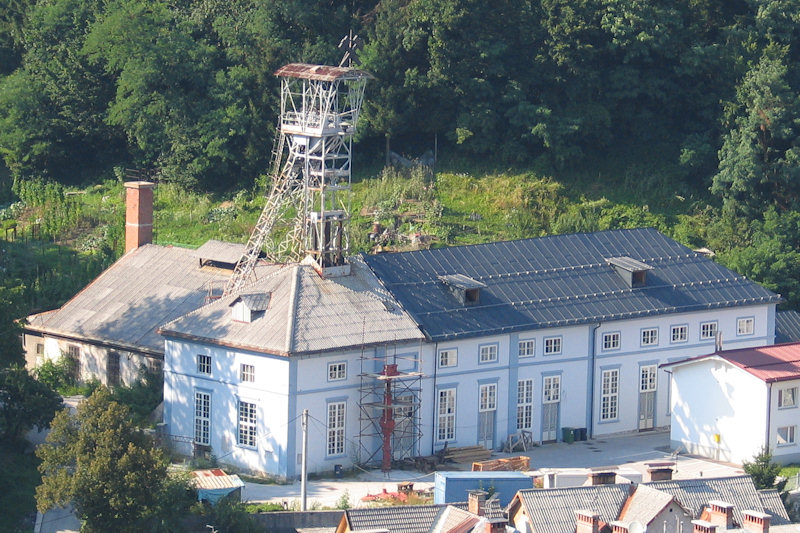
The miner's house – ethnological collection
The miner's house at Bazoviška 4 in Idrija was built at the end of the 18th century. To this day it has preserved the main characteristics of the formerly typical Idrija architecture and miners' living culture. After several years of restoration in the 1990s the house is today protected as a cultural monument, and the ground floor is furnished and takes visitors back to the time of the first half of the 20th century.
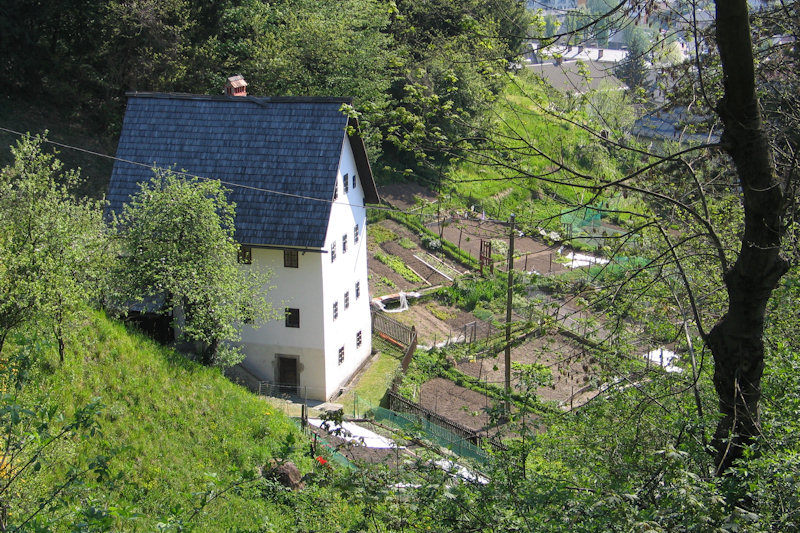
The Idrija miner's house is dug into the slope and turned with its front towards the valley. Its construction is almost entirely wooden, with the exception of the stone foundations, the masonry cellar, and the interior kitchens and hallways. The upper parts of the outer walls are made of boards clad with battens, plastered and whitewashed with lime. The roof is covered with fir shingles – »šinklni«. Because of its height, white façade and numerous small windows it gives the impression of a mighty, indeed monumental building. Most miners could not afford their own house with a vegetable garden, but were subtenants in private houses and later, after 1870, in residential blocks called »prhauzi«.
In the 19th century about 16 people lived in a single house. Every owner rented out at least one flat. The master had a better social status than the subtenant, since he kept domestic animals (a pig, rabbits, hens and sometimes even a cow) and collected the rent. The lack of space forced families into modest living; and in using the space for sleeping they needed quite a lot of imagination. The youngest child usually slept in a cradle, two in a drawer – the »ladlcu«, the other children slept on a wooden bench with a backrest – the »kanapeju«, on a straw mattress, and the boys in summer even in the attic.
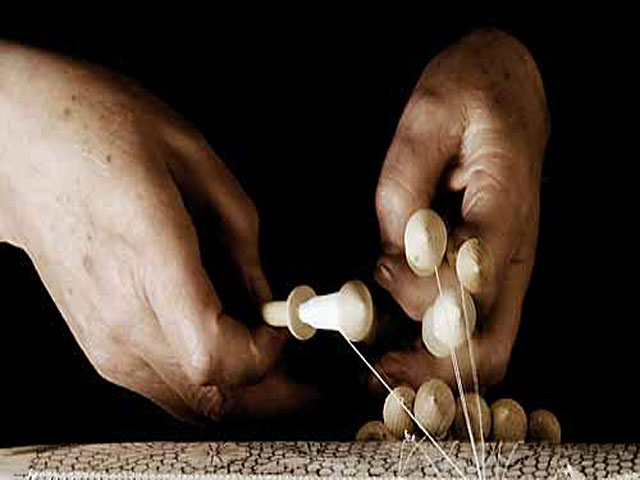
Songbirds too found their place in the house. Cages hung on the walls or stood on cupboards and window sills. The miners were always sociable; in the evenings they liked to gather for conversation, parlour games and various tasks. The women and children, meanwhile, made bobbin lace.
Location
Bazoviška 4, 5280 Idrija
Open:
every day: 9.00–16.00 accompanied by a guide from the Idrija Municipal Museum
Information and group bookings:
tel.: +386 5 37 26 600
fax: +386 5 37 73 580
e-mail: tajnistvo@muzej-idrija-cerkno.si
Admission / person:
adults – 3,00 €
young people (primary pupils, secondary pupils, students) – 2.00 €























 Grad gewerkenegg – gradski muzej Idrijaa