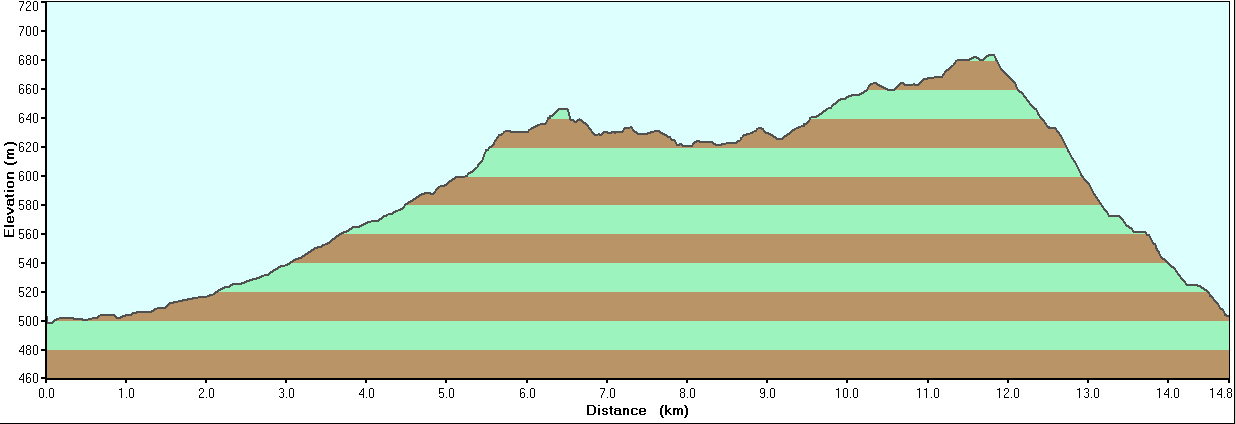
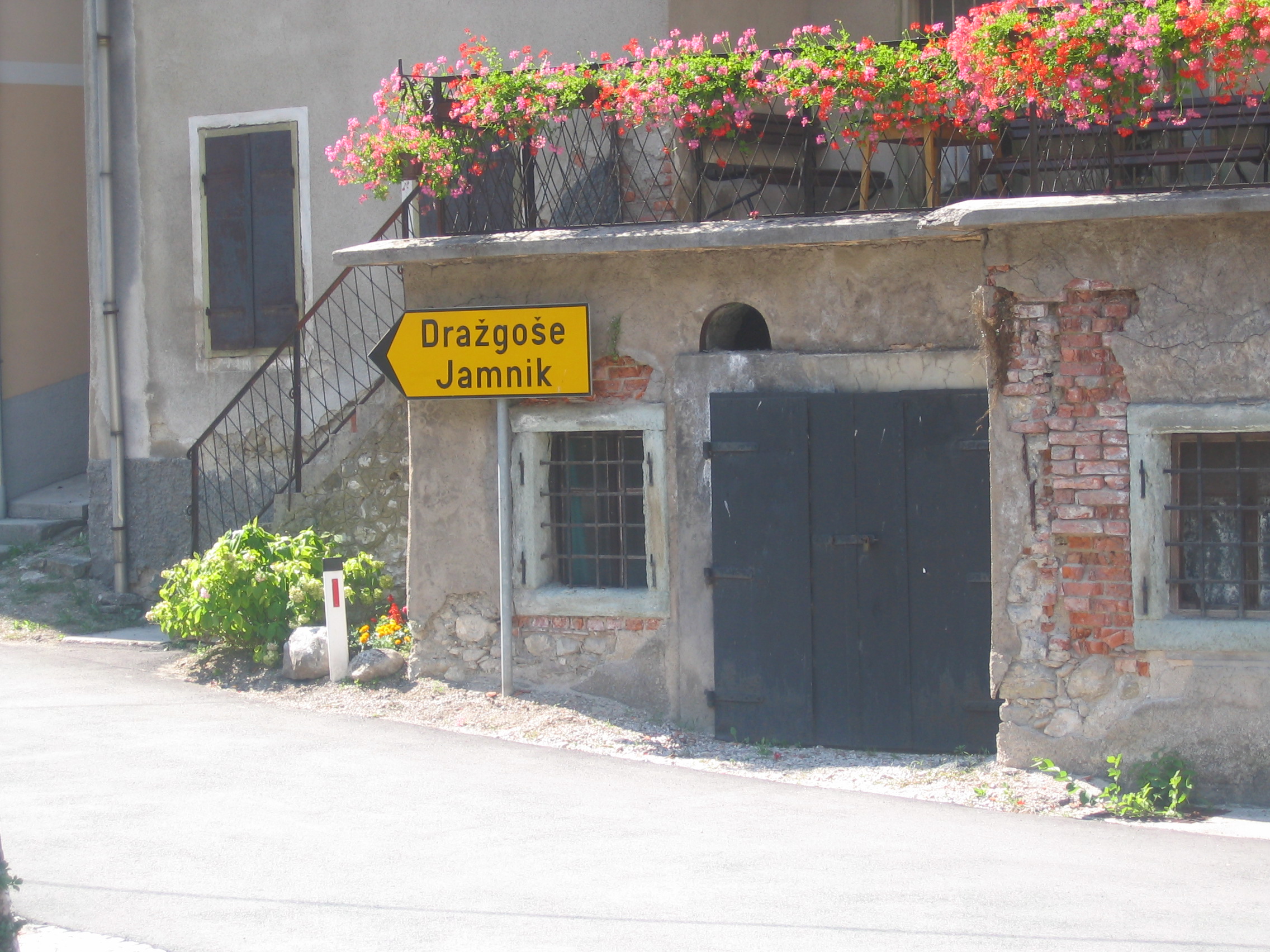
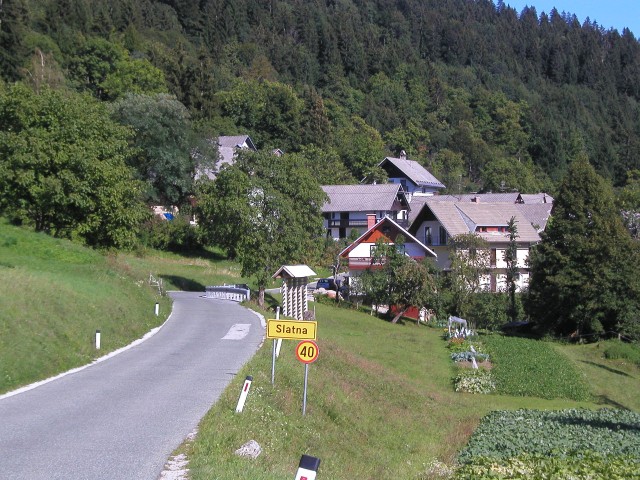
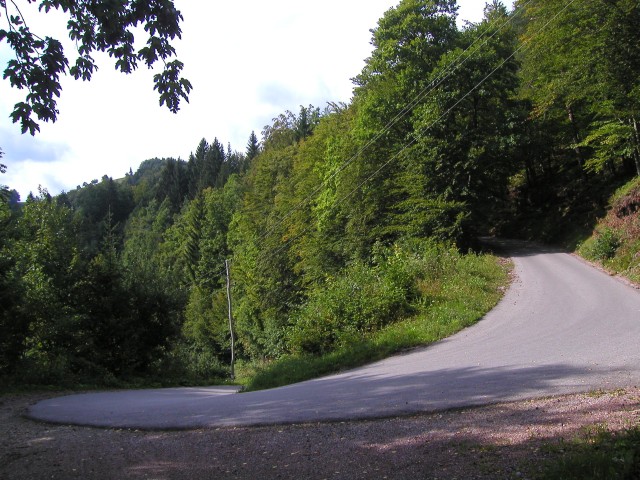
We start the route in Lesce at the Tulipan inn in the direction of the centre of Lesce. After 300 m, at the spaghetti house and pizzeria, we turn right towards Begunje. We ride past the Alpine Flying Centre and come to the village of Hlebce, on past the village of Zgoša, past the Elan ski and boat factory, and we are already in Begunje. On our right is the Avsenik inn, and we ride straight on through the village to the signpost at the end of the village. There we turn right for Tržič. The route rises slightly all the way to the village of Brezje pri Tržiču. We ride up the hill and come to the village of Slatna. Then we continue the route to the village of Srednja Vas and up a smaller rise to the village of Hudi Graben. The route leads us on to the village of Brezje pri Tržiču.From here Tržič can be seen nicely and of course the villages around the village. All that awaits us is a smaller and not too demanding descent to the desired destination, where our route also ends.
Near Begunje are the partly restored ruins of Kamen castle, which the Ortenburgs built in the 12th century. In the village stands the Katzenstein manor, in which the Gestapo prisons were located during the Second World War. Today part of the building has been converted into a museum of the hostages. The place is known for the Elan factory and for the Avsenik brothers' ensemble; the brothers were born in Begunje and also have a family inn there. The church of St Ulrich in Begunje na Gorenskem is a Roman Catholic church which was built at the end of the 14th or the beginning of the 15th century. It was renovated in the Baroque style in 1740. At that time the new church and the parsonage were roofed with tiles from the abandoned Kamen castle. From there the side stone altar of the Mother of God with its painting was also brought over from the former chapel. The altar paintings in the church are the work of Leopold Layer from Kranj.
The Church of St Peter on Gora above Begunje is a Roman Catholic church and is renowned as one of the most interesting monuments of church architecture and painting in Gorenjska. The church is from the 16th century and is famous above all for the frescoes of Jernej of Loka. The medieval builders did not put the church on the top of Gora, but right beside the stone entrance to a narrow shaft, above which a small chapel stands today.
The Brezje plain is like an altar table in the natural cathedral of the Julian Alps, the Karavanke and the Jelovica. With Brezje the Slovenian symbolic axis of the high Upper Carniola begins, which runs by way of Bled and Bohinj to the Triglav. The basilica of Mary Help of Christians is a Neo-Renaissance building and arouses an impression of mightiness. It is 39 long, 19 wide and 17 metres high. On the façade, between two semicircular columns of red marble, there are artistically made double doors to the design of Janez Vurnik. On the right leaf, from the bottom upwards, are carved images of the prophets who foretold the Virgin's birth: Moses, David and Isaiah. On the left leaf the Virgin's prefigurations are depicted: Sarah, Rachel and Judith. Above the lintel of the main doors is a marnle relief of Mary Help of Christians. On the left side of the relief are the angels Raphael and Gabriel, and on the right a woman on a sickbed who, together with her family, trustingly asks Mary Help of Christians for health. The bell tower of cut stone is 53 metres high. In it four bells sang at first. The three larger ones the First World War took away and they were temporarily replaced with steel ones, until in 1932 the church again received bronze bells. In the time of the German occupation the Brezje bells were again in danger. This time they were saved by the master organ builder Franc Jenko.The parish church of the Annunciation of Mary stands beside the Tržič cemetery. To it you walk through the old town core, past the church of St Andrew, along Partizanska ulica and then past the Kurnik house along Cerkvena ulica. The single-naved church with two chapels and a dome was designed in 1808 on the foundations of a Gothic church from the 16thcentury. The dome and the walls are adorned by Layer's frescoes. The Mally house stands at the beginning of the main street in the old town core. It belongs to the group of burgher-noble mansions, and the Renaissance portal with the date 1618 shows the rich late Gothic and Renaissance period of the town. A ridged vault from the 17th century is preserved on the ground floor and the upper floor. Characteristic are the wrought-iron doors (safety against fires) , the open roof structure (drying openings for drying hides) and the Classicist façade from the beginning of the 16th century. At the entrance to the town, opposite the Pr`Slug inn, you set off on a shorter walk which after about 10 minutes brings you to the top of a hill, where the church of St Joseph stands and from where a most beautiful view of the old town core of Tržič opens up to you. The Upper cottage in which the Tržič Museum also has its premises is located in the old town core of Tržič. An example of a rich Classicist mansion, its exterior recalls the characteristic way of building in the town after the severe fire of 1811 – an articulated façade with wrought-iron shutters; on the roof there are drying openings , where they dried flax. On the first floor is the living part, on the second the representative one, in which an ornamentally and figurally painted burgher salon from the middle of the 19thcentury stands out. The birthplace of the Tržič poet Vojteh Kurnik stands on the other side of the upper bridge over the Tržiška Bistrica. The building represents burgher – craft architecture from the 18th century. The first floor is adorned by a long wooden balcony – gang. The building is one of the rare ones , which is still roofed with wooden roof tiles – šinklni or rather shingles. On the roof drying openings are noticeable , which were intended for drying stockings. The doors and windows , walled with stone frames of green Perač stone, are small, as are the vaults inside. In this way they saved a little on energy. Inside the house there is a black kitchen, a chamber, a small room – štibelc, where a memorial room is arranged, and a living space called the ‘house’. In the ‘house’ the former shoemaker's workshop is presented. Neuhaus Castle on a rise above the town core. Most probably it came into being with the new settlement and represented the seat of authority over the upper part of Tržič. The castle changed owners several times. The Dev house is the birthplace of Anton Feliks Dev – religious name Janez Damascen Dev (1732 – 1786). In 1779 he published the first almanac of Slovenian poems – Pisanice, which means that besides being editor and publisher he was also the founder of Slovenian secular poetry. He also wrote the first Slovenian libretto – the text for an opera – Belin.