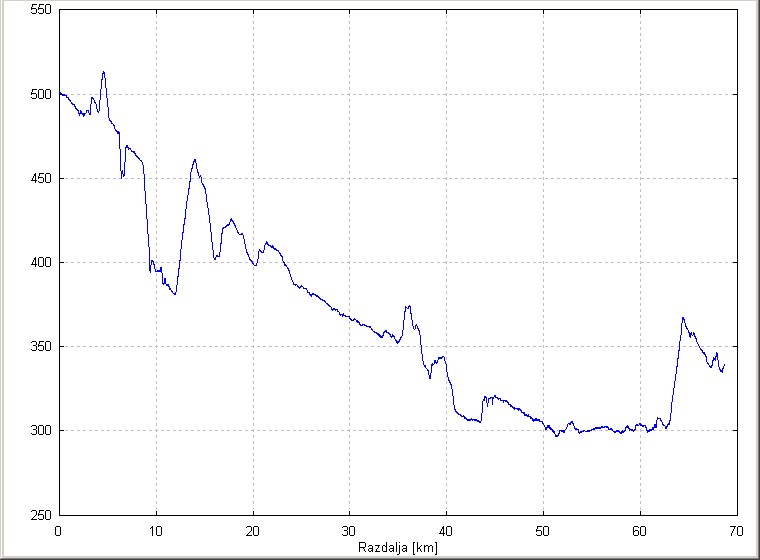
The route runs along roads that allow you to reach the destination in Grosuplje as quickly as possible. Ljubljana, Škofljica and Grosuplje can be starting points for more attractive routes.
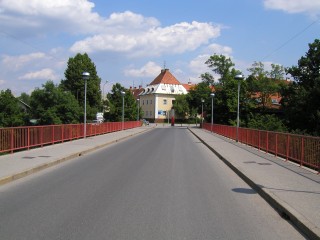
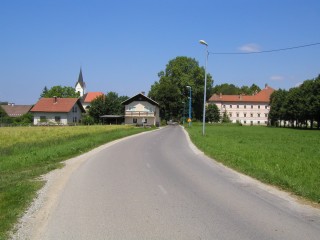
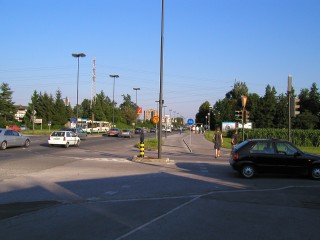
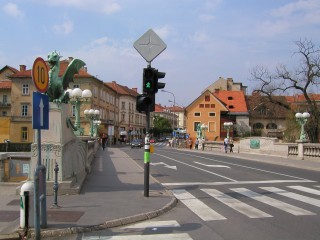
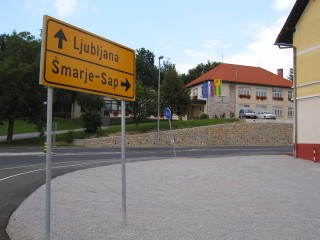
From Lesce we set off towards Radovljica. We ride past the main bus station, then turn right and continue past the police station. The priority road ends at a junction, where we go straight on. Soon we approach the main road, alongside which we continue to Podvin. There we turn right. When in Mošnje before the church the road forks, we continue right to a junction, where a wooden sign Graben directs us left. The road crosses the stream and joins the main road Črnivec – Posavec – Kranj, along which we continue to Naklo. There, after the petrol station, we turn left onto a narrow asphalt parallel road which leads all the way to Kranj. In Kranj, after the petrol station, a footpath continues, which crosses a traffic-light junction and continues to the main bus station. There we turn right, go past the police station and turn left. At the end we continue right and on straight ahead into the old town centre. In the centre we turn left and go over the bridge across the Kokra. After the bridge we turn right and continue straight on, or rather along the priority road, all the way to Tacen. We continue right across the Sava and straight on to the second traffic lights (after a smaller climb). There we turn right, and after the railway underpass immediately left. The road continues with a cycle path under the motorway. Further on we go along Prušnikova cesta to Celovška. We continue along the cycle path beside Celovška cesta and straight on beside Gosposvetska, we cross Slovenska cesta. At the end of Dalmatinova we turn right and then left onto Trubarjeva cesta. Then we turn right onto Kopitarjeva, we go over the Dragon Bridge. Before the tunnel we go left across the pedestrian crossing (turning left is prohibited). Along Streljska ulica we go straight on to Roška, where we turn right to Karlovška cesta and turn left onto Dolenjska cesta. Along it we go out of Ljubljana straight on to Škofljica. There we first turn right towards Kočevje and immediately left in the direction of Šmarje-Sap. At the end of Cikava we turn right and arrive in Grosuplje.
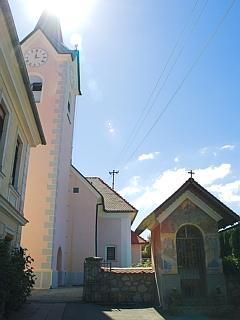
In the middle of the village Naklo stands the church, which is dedicated to the patron St Peter. It is single-naved and built in the shape of a Latin cross and is thus a fine example of Baroque building. In it we can admire quite a few exceptional works of art. The main altar and the statue of St Peter are the work of Jospi Götzl, and the altar painting Jesus hands the keys to St Peter was painted by the famous painter Leopold Layer, who also created the painting of Mary at Brezje. A pride of the church is also the exceptionally fine Way of the Cross, which is the work of the artists Josip Wolf and Jan Vurnik. The church of St Nicholas at Brdo in Strahinj was built around the year 1382 on a small rocky rise. It is dedicated to St Nicholas – in the local way St Miklavž. Around the church there was once a cemetery. The greatest attraction of the church is the fresco in the space below the bell tower. It was created in the 14th century and has great historical value.
Polica is located on the terrace between Kranj and Pivka. The terrace is part of the Udin boršt, which in the Temnik gorge comes closest to the Dobrava. Through this gorge in 1908 the railway towards Tržič was laid, while today the tracks end already in Naklo. Out of conglomerate rock the Puhar family carved millstones at Polica for more than 300 years. At Polica today there is the junction onto the motorway Ljubljana – Jesenice. Today it is known for the folk artist and sculptor Janez Vovk and for Anton Grašič, the world-famous collector of antiques. At Polica you can stop at the Poličar farm, where you will get all farm produce, and at the neighbouring farm Pr’ Škofče they will teach you to ride horses.
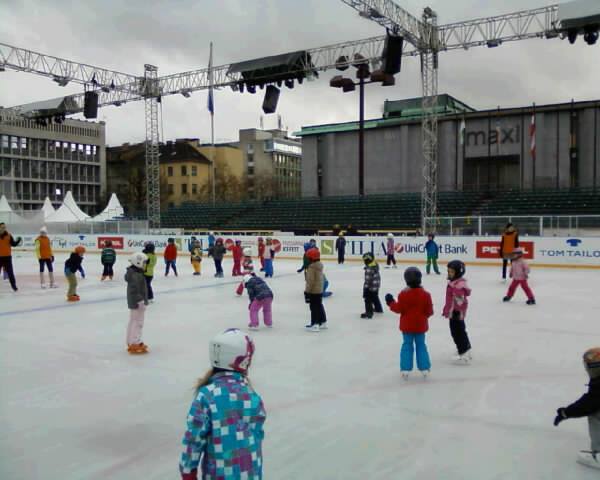
Kranj is the largest town in Gorenjska and the fourth in the state of Slovenia. The old town centre rises steeply like a kind of peninsula above the confluence of the rivers Kokra and Sava. Because of its strategic position Kranj was in history an important trading centre and the town has kept this status still today. The houses in the old town centre are arranged around a rectangular square with a well, the Town Hall and the parish church of St Cantianus and companions. Kranj is especially known for the Prešeren Memorial Museum and Prešeren's grove, where Dr France Prešeren is buried. In the grove you can likewise see the first monument dedicated to the Basovizza victims, the monument to the poet Simon Jenko, the mausoleum of the Kranj family Majdič. Worth seeing is the Gorenjska Museum in the Town Museum, where there are archaeological finds, very numerous from the Old Slavic period, and where you can look at the wealth of folk art in Gorenjska. In the town there are many more attractions that can be seen: the town wall, Khieselstein castle, the Rosary church, the Kranj grammar school, Plečnik's staircase, the Prešeren Theatre, on which our architect Plečnik left his mark, the Pavšlar and the Toll-collector's house; you can enjoy nature – the Kokra canyon,…Kranj is also a very lively year, since throughout the year various events take place. In the summer months the Carniola festival takes place, the largest event in Gorenjska Kranfest (the last weekend in July), in February the Prešeren fair, the Carnival, in December the event Merry December with the St Nicholas and Christmas fair…. On the northern edge of the town of Kranj, in a fresh green setting, is a real venue of possibilities for sporting activities. The Kranj Sports Centre offers the possibility of recreation in a new summer pool, a covered Olympic pool, on grass football pitches and on several tennis and basketball courts. For young families, besides the Sports Park, a children's playground GibiGib has also been arranged. At the racecourse of the Brdo estate, every autumn on the first Sunday in September, interesting trotting races are organised.
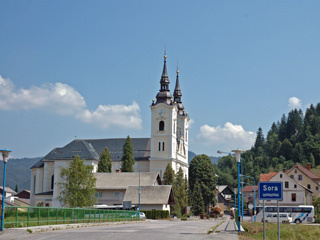
The people of Grosuplje and those in the immediate surroundings were engaged in farming, carting, milling, and also in brickmaking and tanning. Around Šmarje and across the wider Dolenjska region they grew flax and hemp. In 1893 they built the railway towards Kočevje and then also towards Novo mesto. From the tourist point of view, Grosuplje admittedly a young settlement, but its central and traffic position, natural assets and special features, varied historical and cultural heritage and the time which the people of Grosuplje live and shape together in the young Slovenian state give it possibilities which it tries to make use of together with its hinterland. Boštanj Castle was a typical building of that time, markedly adapted to local, aesthetic, economic and socio-cultural conditions. Of the castle of that time only the northern tower remains, a long blind wall with an attic mounting for a clock, a partly preserved portal and a few smaller hewn stones for window frames, roof and other corbels, arrow slits, a latrine outlet, stone steps and a few arched lintels built of brick and tufa. In the middle of a clearing in the forest at Gradišče near Boštanj pri Grosupljem the Lambergs of Boštanj erected at the beginning of the 17th century the small hunting castle Zavrh – Saverch , which the counts Ursini Blagaj in the following century turned into the Boštanj castle outfarm and also used as a hunting lodge. By today's Ljubljanska cesta in Grosuplje, right beside the Grosupeljščica stream, stands the heavily remodelled small castle Brinje, a single-storey building of almost square ground plan with a pyramidal roof, an arched stone portal and a balcony above it. In 1894 the mansion was bought by the postmaster Matija Hočevar from Velike Lašče and the Ljubljana merchant Franc Hočevar, and a year later by Ignac Valentinčič from Ljubljana, and it is in the ownership of that family to this day. Magdalenska gora above Grosuplje is ranked among the best-known archaeological sites in Slovenia. The finds, which mostly originate from the 8th to the 1st century BC, are today held by museums in Ljubljana, Vienna and Harvard.