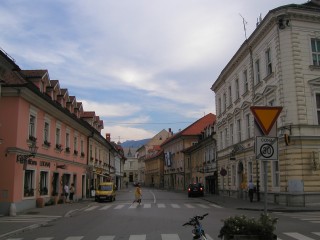
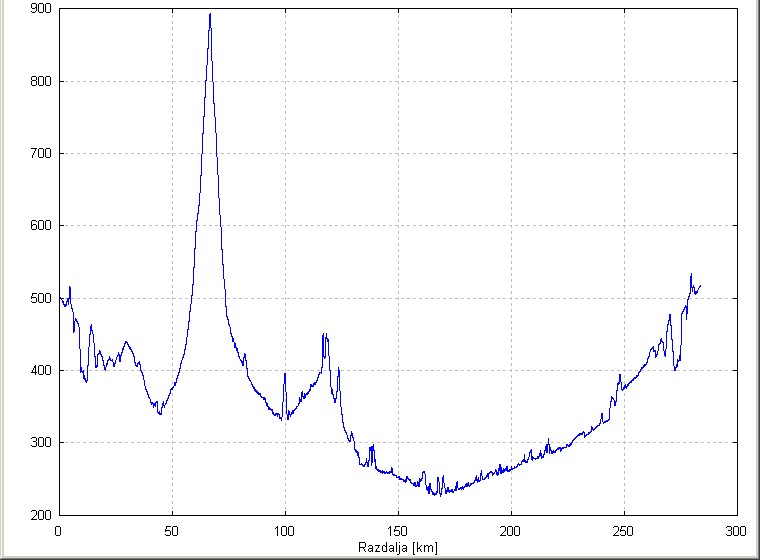
From Lesce we set off through Radovljica, Podvin, Mošnje, Posavec and Naklo to Polica. At the traffic-light junction we turn left and continue through Kokrica, past Brdo Castle to Britof. At the traffic-light junction we turn left in the direction of Jezersko. In Visoko we turn right towards Cerklje. At the end of Cerklje we continue left towards Zalog and on to Komenda. There, at the beginning, we turn left and continue along the priority road to Križ. We come to the main road, where we turn left towards Kamnik. There we go straight on through the old part of the town, on through Mekinje and over the Črnivec pass (the highest point of the route, 902m) to Gornji Grad. Before the petrol station we turn right in the direction of Nazarje. After crossing the Savinja we turn right and in Mozirje at the roundabout right again. Along the main road we continue to the turning for Šoštanj, where we turn left. After a shorter climb we descend into Gorenje, where we go straight on along the main road. At a larger junction we turn left onto the road towards Šoštanj, where there is a height limit of 3.3m. Through Šoštanj we go past the thermal power station on into Velenje. We ride along the main road until on the right we catch sight of the ski jump. We turn right and along a parallel side road return back and climb up to the castle. After the descent from the castle we turn left at the first junction. The descent continues to the main road, where we turn right. Along the main road we go to the turning for Arnače, where we turn left. At this junction there is a sign for Polzela (9km) and back for Velenje (3km), while in the direction of Arnače there is only a sign for the tree nursery. Along this road we go to the junction where to the right it is 2km to Ponikva. We turn left in the direction of Vodosteč to the main road, where we turn right. When we cross the motorway, we turn right towards Arja vas. We continue straight on through Petrovče and cross the Savinja. At the turning for Sp. Brnica we turn left. The road with a 2km stretch of gravel leads to Celje. Along the main road through Laško we continue to Zidani Most. There we turn right past the railway station along a narrow road towards Hrastnik. There we cross the river Sava and along the main road continue past Trbovlje and Zagorje to the turning for Sava. We turn right across a narrow bridge, and then left alongside the railway continue to Litija. On we go along the main road to Kresnice, where we cross the Sava to the left. Along a side road we continue to Laze, and then turn right and cross the Sava. In Dolsko we turn left and along a side road through the villages continue to Šentjakob. Along the main road we go to the bus station, and then turn left onto a side road through Črnuče. After crossing the Sava we turn right. In Tacen we cross the Sava again and immediately turn left. Along the main road we continue straight on through Smlednik towards Kranj. We cross Kranj through the old part of the town, past the bus station. From Polica onwards we continue along the route by which we came.
The medieval town of Radovljica grew up in the 14th century on the river terraces above the confluence of the Sava Bohinjka and the Sava Dolinka. The medieval wall with a defensive ditch encircles unique examples of medieval architecture in Slovenia – the Radovljica manor, the church of St Peter, the Šivec house, the Mali house with a pillory and the castle park. In Radovljica is the only town hotel Grajski dvor, the work of the architect Ivan Vurnik. The hornbeam avenue (from the hotel towards the old town centre), beside which lies the tomb of those who fell in the Second World War. The avenue is a remnant of the manor's Baroque garden, which the Thurn-Valsassina family had laid out in the 17th and 18th centuries. The late medieval defensive ditch has been restored in recent years (entrance into the old town centre). The upper town gate (entrance into the old town centre), which was once guarded beside the drawbridge by a vaulted defensive tower. The central town square has on each side beautifully maintained monuments of medieval and Renaissance burgher architecture. Radovljica is the birthplace of Anton Tomaž Linhart; his birth house from 1634 can be seen. You can also visit the Lectar house, in which there is the oldest Radovljica inn. The entrance portal, from 1822, is the work of the well-known stonemasonry workshop of the Kocjančič family from Črnivec. The manor in the old town centre was originally connected with the hornbeam avenue by a wooden corridor, and later by an embankment usable still today. The original Ortenburg castle was rebuilt after the earthquake of 1511 by the then tenant count Dietrichstein, and a century later it was additionally extended by the counts Thurn-Valsassina. On the ground floor today there is the Music School, on the first floor the Beekeeping Museum, which shows the heritage of Slovenian beekeeping. Here there is also a museum presentation of the life and works of Anton Tomaž Linhart. The church of St Peter was built 750 years ago in Romanesque style. In the middle of the 15th century it was rebuilt and enlarged.
The parish church of the Assumption of Mary is the largest church in the municipality of Cerklje. It stands in a dominant position in the centre of the village, where, in the opinion of historians, the first church stood as early as the 9th century. The high altar of this church is one of the richest late Baroque creations in Upper Carniola. Opposite the parish church of the Assumption of Mary stands the Art Nouveau Hribar villa. Here the long-serving mayor of Ljubljana I. Hribar spent his summers. The Hribar villa is not used for tourist purposes. In front of the more recent church of the Assumption of Mary standing today there is a bust monument to the composer Davorin Jenko, the work of L. Dolinar, who came from Plečnik's school. In Cerklje you can also see the remaining sights: the Borštnik house and the memorial plaque to Ignacij Borštnik, the Obelisk, the monument to the victims of the war, the Cemetery, whose entrance section and chapel are the work of Jože Plečnik, the Monument to the First World War beside the church, the Barle house, the Memorial plaque on the façade of the fire station, the Old village core, the Memorial park.
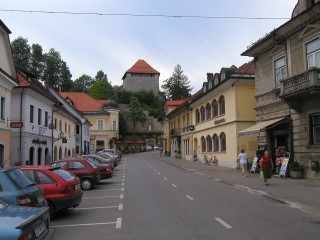
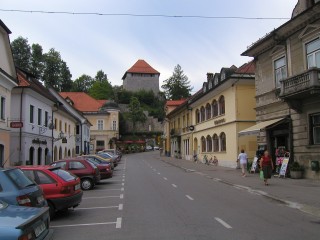
The town of Kamnik together with its surroundings offers numerous possibilities for sporting activities (tennis, beach volleyball, a summer Olympic pool with a camping area), which make free time more pleasant to spend. A unique natural feature is the Kamniška Bistrica valley (the Predoselj gorge with the Natural Bridge, the Koželj walking study trail). East of the Kamniška Bistrica rises the largest and most visited plateau – Velika planina. Increasingly, the Snovik Spa in the Tuhinj valley is also establishing itself as an interesting tourist and recreational destination, with pools, saunas and other activities of a recreational and social character. There is also a rich catering offer. Just a few kilometres from the town a wonderful park stretches out, the Volčji Potok Arboretum. The rise in the middle of the town, called Mali grad, is enriched by a Romanesque chapel and a restored defensive tower, once part of the medieval town wall. On the hills at the edge of the town the entrance to it is guarded by the Renaissance-Baroque Zaprice mansion, which has been converted into a museum, while in front of the building there is an ethno park (skansen) with granaries from the Tuhinj valley. Also worth seeing is the Franciscan monastery with its rich library, which holds around 10,000 volumes from various fields of learning. In Kamnik there is the oldest private museum collection in Slovenia, founded in 1893 by Dr Josip Nikolaj Sadnikar. St Primus above Kamnik attracts a large number of visitors throughout the year. The frescoes in the church of Sts Primus and Felician are one of the highest-quality works of painting of the Middle Ages in our country. At the same time the church represents one of the rare monuments of Gothic architecture in the Kamnik area (15th century)
Above the town of Šoštanj stand the ruins of Pusti grad. The castle came into being in the 12th century, as the masonry of the remains of the tower testifies, while it was already demolished in the 15th century. Above the old market-town core stands the church of Sts Hermagoras and Fortunatus, originally still a Romanesque building, which was rebuilt many times. From the oldest period the presbytery with a Romanesque window from the first half of the 12th century and Gothic frescoes from the 14th century have been preserved. In the church there are today two quality Baroque altars, which were brought here from the demolished church of St Michael in Družmirje. The new parish church of St Michael, where the seat of the Šalek deanery is also located, stands at the edge of the town, already in the settlement of Skorno pri Šoštanju. Long before we arrive in Šoštanj, the cooling towers and chimneys of the largest Slovenian thermal power station announce the town to us; for a number of years it heavily polluted the near and distant surroundings, but in recent years, with the construction of purification plants, it has done much for the ecological cleansing of the Šalek valley. In the town there are several more interesting buildings, of which let us mention the Široko villa beside the town stadium and the building of the former Kajuh Home hotel, which was built in the 19th century in the Neo-Renaissance style. In this building the Slovenian poet Karel Destovnik Kajuh was born (a memorial plaque in his memory is set into the building; the relief on the plaque is the work of the sculptor Ivan Napotnik). In the House of Culture there are the Ivan Napotnik gallery and a music school. Among the monuments in Šoštanj the monument to Karel Destovnik Kajuh is worth mentioning.
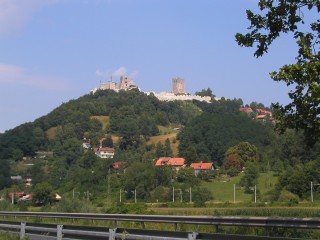
On arriving in Velenje from the Celje direction, on entering the Šalek valley you will catch sight of the mighty Velenje Castle. It is first mentioned in the middle of the 13th century, when it is said to have been in the hands of the lords of Kunšperk. The castle has a five-pointed perimeter adapted to the terrain, within which there is a courtyard with a well. From the 14th century onwards the castle changed owners several times. It acquired its present appearance at the beginning of the 16th century, after which it was enriched up to its present form: the castle consists of a palace core with vaulted cellar rooms, a curtain wall with defensive towers and a mighty roundel, and a wonderful castle courtyard surrounded by arcades. In it the Velenje Library – Events unit organises various cultural and musical events. Šalek Castle, which lies above the settlement of the same name, is probably the oldest castle building in the Šalek valley, since the valley is in fact named after it. The castle was abandoned after 1770 – the castle tower, which has for the most part been preserved to this day, was the oldest part of the castle and is remarkable on account of its shape, since it is triangular in ground plan and as such unique in the Slovenian area. The church of St Andrew, lies below Šalek Castle. Its, almost untouched Gothic form is invaluable for the study of medieval thinking in the valley. Outside and inside it is decoratively painted. In the town there also stand the church of St Martin, which is one of the oldest churches in the Šalek valley, and the Mother of God, a Gothic church remodelled in the 18th century, with rich furnishings; while in the vicinity we find several more sacral buildings preserved to a greater or lesser degree. Velenje offers many more sights that ought to be seen.
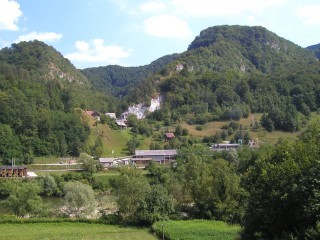
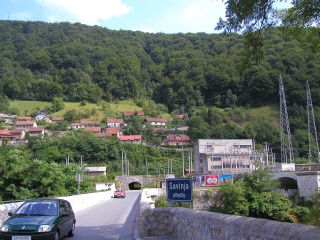
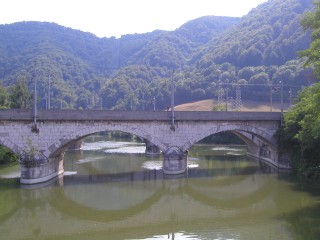
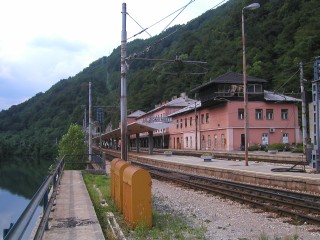
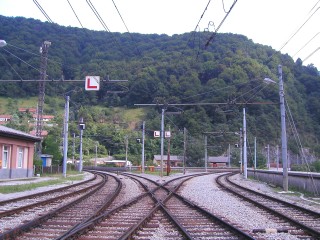
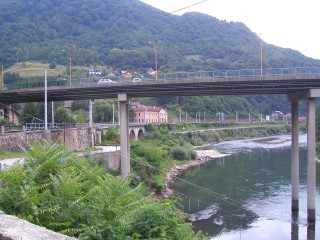
Zidani Most is a straggling settlement in the municipality of Laško. It is situated in a gorge at the confluence of the river Savinja with the Sava.Across the Savinja run two railway bridges and a stone road bridge. The settlement is mentioned under the name Kamniti Most together with the church of St Giles in 1224. In the 15th century the Celje commander Jan Vitovec, during the fighting with the Habsburgs, destroyed the bridge and the castle from the 13th century.In the place there is a filial church of the Sacred Heart of Jesus. Not far from Zidani Most, upstream along the Sava, the entire slope above the left bank of the Sava is in fact one great tufa formation. It is marked by three small streams which fall in fairly high waterfalls. The middle little waterfall is more than 25 m high and falls in a broad curtain of water. To the right a small stream runs in a 15 m high little waterfall. To the left there is a modest little stream which has created a tufa waterfall about 5 m high. The waterfalls are "flowing" in the rainy season, while in drought they dry up or a damp wall remains. Cicka’ is the name for a gondola-like means of transport which the locals used for crossing the river Sava. Today one more cicka is in operation, at the first crossing over the railway line in the direction Zidani Most – Hrastnik.