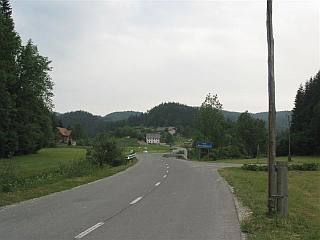
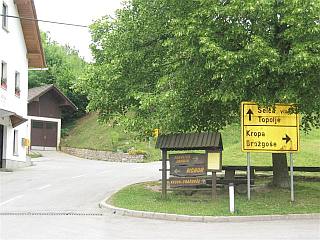
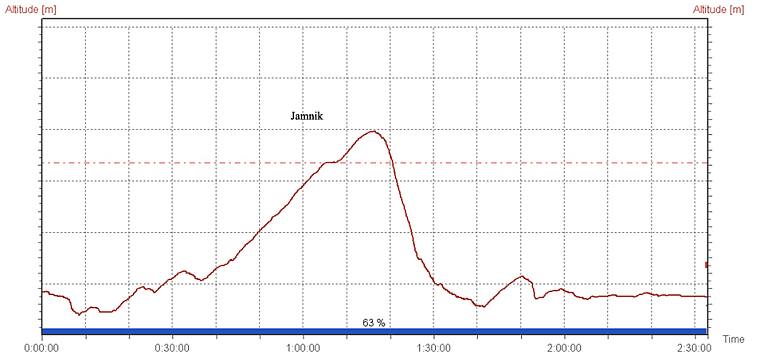
The route begins at Kokrica and continues towards Kranj. At the first traffic lights in Kranj you turn right, and at the second you go straight on, down the slope, past the former fairground (now it is a shopping centre), across the bridge, and at the end of the bridge turn right towards Besnica. The road leads under the railway underpass; at the top of a small little slope, then ride along the main road towards Besnica. Soon on the left-hand side you will catch sight of the plastić ski jump where our jumpers train. After 1km of cycling we come to the place of Besnica. From here on the road slowly begins to climb. After about 8km of cycling we come to the village of Nemilje ( 510m ), then there follows a climb to the village of Podblica ( 700m ), past the village and at the top turn right towards Kropa ( to the left, however, one goes towards Dražgoše). Then you come to the village of Jamnik, and from here on you will soon catch sight of the church of St Primus on the right-hand side. Then there follows a descent towards Kropa, on to Podnart. When you come to Podnart turn right across the bridge and after a shorter climb you come to the junction with another road. Turn right towards Podbrezje. Here a climb awaits us again, which is a little longer but is not too demanding. At the top ride straight on towards Podbrezje. A shorter descent awaits you, across the bridge and again up a shorter slope towards Naklo. Then through Naklo to Polica, and at the traffic lights turn left if you are going towards Kokrica, or straight on for whoever is going to Kranj.
Kokrica lies on damp ground north of Kranj, at the crossroads of the roads leading to Golnik, to Naklo, Preddvor and Predoslje. The book History of the Town of Kranj mentions Kokrica as early as the 11th and 12th centuries, when the Patriarchs of Aquileia held ownership over it. In the 14th and 15th centuries Kokrica belonged to the Ortenburg estate. The settlement was originally called Kakericz and is of pre-Slavic origin, and means little Kokra. At Kokrica the Bobovek lakes are located. The natural feature of the little lakes at Bobovek covers the area around the three little Bobovek lakes: Čukova jama, Krokodilnica and Ledvička. During the First World War a brickworks began operating at Bobovek, and its owner was the local man Zabret, known as Čuk. The pit which came into being then through the digging of clay is for that reason still called Čukova jama today. After the Second World War a second pit was dug, to which, however, the curious name Krokodilnica stuck, even though there were never any crocodiles in the vicinity. Along these banks children in the past liked to ˝slide down on their bums˝ and because they had green trousers, they were told they were as green as crocodiles. Hence too the name Krokodilnica. A thirteen-metre excavation into the depths opened up an interesting view into a past some three hundred thousand years old. According to all the data obtained, there is said to have been a lake here many years ago. This is confirmed by the excavation of the fossil remains of a shoal of dace at a depth of 8 m. They are said to be around 180000 years old. Very interesting, however, is certainly the find of the remains of a mammoth skeleton at a depth of 8.5 m below the surface. From the weaker bones they conclude that it was a female, and from the wear of the molars they conclude that at death it had passed forty years of age. It probably strayed into the marsh and sank there, or else it was driven there by Ice Age hunters, who probably lived here in the vicinity. A few years after the war the brickworks was nationalised, and in 1971 it ceased operating, since the digging was halted by groundwater at the level of the Kokrica stream. The excavated pits were thus flooded with water, and because of the clay the water also remained in them. Three little lakes came into being. Apart from everything listed, the clay is also worth mentioning. The clay which is found in the lakes is medicinal, since it is mentioned in his books by the well-known herbalist and Father Simon Ašič. The clay helps with virtually all ailments (fracture, trouble with teeth, corns, burns, suppurating wounds, it cleanses the organs of the urinary tract etc.). Many villagers have already tested the healing power of the clay on themselves, and laboratory examinations have also scientifically confirmed the healing power.
In the church of St Lawrence at Kokrica a Gothic navicula was found (a little ship, a vessel in the shape of a ship used for church rites) with the date 1533, on which there is the inscription: “Jesus, Mary – help us out of all distress”. From this it can be concluded that the church was built in the 17th or even the 16th century.
Kranj is the largest town in Upper Carniola and the fourth in the state of Slovenia. The old town core rises steeply like a kind of peninsula above the confluence of the rivers Kokra and Sava. Kranj was, on account of its strategic position, an important trading centre in history, and the town has retained this status to this day. The houses in the old town centre are arranged around a rectangular square with a well, the Town Hall and the parish church of St Cantianus and companions. Kranj is especially known for the Prešeren Memorial Museum and the Prešeren Grove, where Dr France Prešeren is buried. In the grove you can likewise see the first monument dedicated to the Basovizza victims, the monument to the poet Simon Jenko, and the mausoleum of the Kranj family Majdič. Worth seeing is the Upper Carniola Museum in the Town Museum, where archaeological finds are located, very numerous ones from the Old Slavic period, and you can look at the wealth of folk art in Upper Carniola. In the town there are many more sights which it is possible to see: the town wall, Khieselstein Castle, the Rosary church, the Kranj grammar school, Plečnik's staircase, the Prešeren Theatre, on which our architect Plečnik left his mark, the Pavšlar and the Toll-collector's house; you can enjoy nature – the Kokra Canyon,…Kranj is also a very lively year, since throughout the year various events take place. In the summer months the Carniola festival takes place, the largest event in Upper Carniola Kranfest (the last weekend in July), in the month of February the Prešeren fair, the Carnival, and in December the event Merry December with the St Nicholas and Christmas fairs…. On the northern edge of the town of Kranj, in fresh green surroundings, is a real arena of possibilities for sporting activities. The Kranj Sports Centre offers the possibility of recreation in a new summer pool, a covered Olympic pool, on grass football pitches and on several tennis and basketball courts. For young families, beside the Sports Park a children's playground GibiGib has also been arranged. At the racecourse of the Brdo estate every autumn on the first Sunday in September interesting trotting races are organised.
The Besnica valley has many sights and peculiarities. On the Nemiljščica at Zg. Besnica the Šum waterfall hides, which is about 16 metres high and is a very popular excursion point. Above the Šum waterfall on the Nemiljščica the remains of the former “Roman Baths” are preserved. The baths came into being beside a warm spring, which was already mentioned by Janez Vajkard Valvasor in his book The Glory of the Duchy of Carniola. The pool for the baths was built in 1954, but today the baths are unfortunately abandoned. The Besnica valley is surrounded by pre-Alpine hills. A peculiarity among them is the Rovnik, which is a kind of karst outlier. Since it is built of limestone it is full of dolines and various hollows, holes and caves. Among the better known is the Bidevec cave, which about 30 metres long and is very interesting, since in it there are stalactites, curtains and little hedgehogs. In the cave a cave beetle also dwells, which is characteristic only of this cave and therefore also bears the name after Besnica. Besnica is also known for its variety of apple tree – the Besnica waxen apple. On account of the unique taste of its golden yellow fruits and its durability the Besnica waxen apple quickly established itself in the orchards of Upper Carniola. In Zg. Besnica stands the parish church of St Giles or rather St Aegidius. The church is first mentioned as early as 1291. The place where the church stands is one of the finest locations in the Besnica valley. From here there is a very fine view over the whole valley, all the way to Kranj and further still.
The image of the old settlement of Kropa took shape by the end of the 18th century with a row of ironworkers' houses, two churches and technical-ironworking buildings. As a more important industrial centre, Kropa has preserved the characteristics of a Gorenjska ironworking settlement. The narrow valley offered only little space for the settlement. The buildings, which were once the property of the ironworks, are mostly multi-storeyed. Along the stream they lean against the hill, closely one beside the other. Behind, on the steep slope, there were once the huts of the charcoal burners, miners and nailmakers. The square is surrounded to the east by the Tramuš, Pibrovec and Šolar houses, and to the west by the Troha, Vreteno, Poznik and Ažman houses. Very noticeable are the Macol and Klinar houses because of components characteristic of Renaissance and Baroque manors. In the first there was from 1888 to 1957 a primary school, in the second the Smithing Museum is now located. To the left and right of the stream two churches rise above the settlement . Kropa has had its own parish since 1620. The Florian shrine on the Plac connects the main square and the parish church of St Leonard. It stands, namely, at the place where, shortly before the founding of the parish, bishop Tomaž Hren spoke against the Kropa Protestants. The high four-sided roof of the shrine is covered with slate, on the top is a forged image of St Florian. In the niches Mary, St Michael, St Florian and bishop Hren are depicted.
At the southern end of the square is a partisan monument, the work of the sculptor Stane Keržič from 1965. The iron figures were made by the local UKO workshop. The vigenjc is a wooden building by the watercourse with a wheel for driving the bellows. For centuries the Kropa smiths, men, women and children, from early morning until night, by the hearths and at the anvils forged various nails for the ironmasters.
At Jamnik, on one of the most beautiful viewpoints with a view over the whole of Gorenjska, stands the church of St Primus – during the Turkish incursions bonfires were lit here. In the ribbed vaulted presbytery there are frescoes from the 1460s. In the centre of the vault Christ is painted, and around him the symbols of the evangelists, angels and the four Fathers of the Church. On the walls are images of women saints and apostles with Mary in the middle. The painter belongs to the circle of the workshop of the Master Bolfgang. The church was remodelled twice, the first time around 1759 and the second time around 1863. The Baroque Stations of the Cross in the church date from 1763.
In the middle of the village of Naklo stands the church dedicated to the patron St Peter. It is single-naved and built in the shape of a Latin cross and is thus a fine example of Baroque building.In it we can admire quite a few exceptional works of art. The high altar and the statue of St Peter are the work of Jospi Götzl, while the altar painting Jesus hands the keys to St Peter was painted by the famous painter Leopold Layer, who also created the painting of the Virgin at Brezje. The church also takes pride in an exceptionally fine Way of the Cross, which is the work of the artists Josip Wolf and Jan Vurnik. The church of St Nicholas at Brdo in Strahunj was built around the year 1382 on a small rocky rise. It is dedicated to St Nicholas – in the local speech St Miklavž. Around the church there was once a cemetery. The greatest attraction of the church is the fresco in the space beneath the bell tower. It came into being in the 14th century and has great historical value.