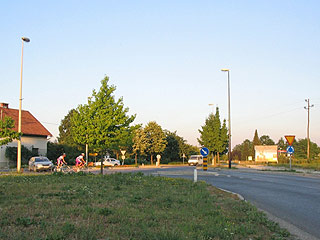
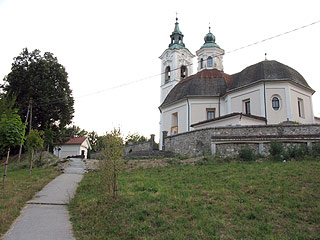
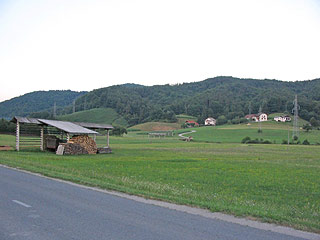
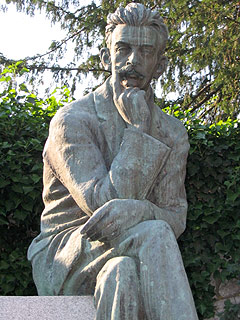
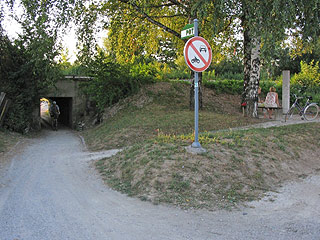
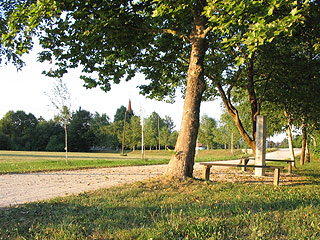
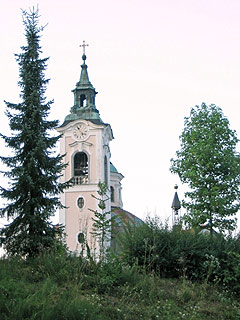
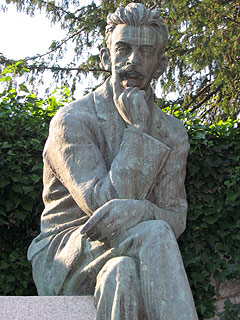
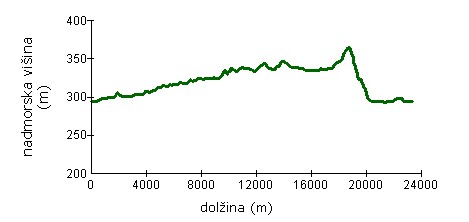
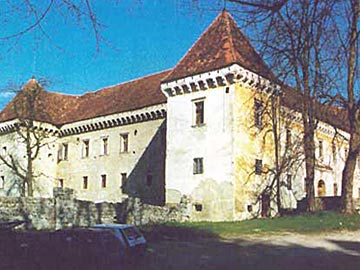
We begin the route in Ljubljana at Dolgi most, by the exit from the Ljubljana-Vič motorway. (If we arrive from the ring road and at the traffic-light junction turn left, on the right-hand side beside Tržaška cesta there is a public car park). The start of the route is at this junction, where we descend through the underpass beneath the railway line and for a few hundred metres join the PST. This is the well-known gravelled Path of Remembrance and Comradeship, about 33 km long, from the 1960s. It is bordered by green areas and avenues of trees, memorial pillars, benches, waste bins, information boards and other equipment. By the church of Sts Simon and Jude and the Vič cemetery we turn left. After about 1200 m we cross the motorway on a flyover. From the flyover a fine view of the Bokalce mansion is offered to us. We continue the route to Dobrova, where at the roundabout we head left towards Horjul. On the right, on a rise, the monastery of the Sisters of Mary and the pilgrimage church of the Assumption of Mary dominate. Along the Horjulščica valley we ride on the asphalt road past Brezje, Podolnica and Zaklanec to Horjul. At the junction we head left towards Velika Ligojna and Vrhnika. A smaller climb over Velika Ligojna and a descent towards Vrhnika await us. Along the level past the barracks and the new primary school we come to the centre of Vrhnika. Besides the Cankar memorial house and monument, there are several more interesting historical buildings and monuments in this market-town settlement.
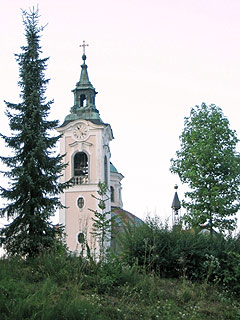
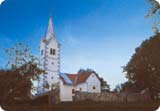
Podolnica lies on the sunny side of the Horjul valley. In the village a few old houses and hayracks have been preserved, as well as the tools of the old craft of wheelwrighting. The people of Podolnica wish to restore this so that it might serve for viewing. At the end of Podolnica, on the translucent side, a dolomite hill rises, where the church of St Ulrich is. There are conjectures that there was a prehistoric settlement by the church. Once the church was fortified; the wall around the church was higher and as many as four little towers served the villagers for storage and for defence against the Turks. The first church was, according to the accounts of the people, wooden. It burned down as early as the beginning of the 18th century, while the present church was built in 1751. For the building of the new church they used up the very stones of the wall, which they pulled down for this purpose, since there was no longer any danger from the Turks. They made a cemetery, blocked up all the arrow slits, and pulled down the western and northern little towers. In 1991 the local people, under the auspices of monument protection, restored part of the wall. Two towers together with their slits are also preserved. The tabor at Sv. Urh is a protected cultural monument, worth seeing.
Horjul is the largest place in the Horjul valley. The people of Horjul were in previous centuries beset by numerous misfortunes and poverty, while after the Second World War the place is progressing economically very fast. In the parish church of Sv.Marjeta there are frescoes by the academic painter Janez Šubic, who painted in fresco in 1877. In the cemetery there is the relief ‘PIETA’, the work of France Kralj from 1923, which has great artistic value, and the wall, which is made according to the instructions of Jože Plečnik. The Horjul cemetery was in those times considered one of the most beautiful.
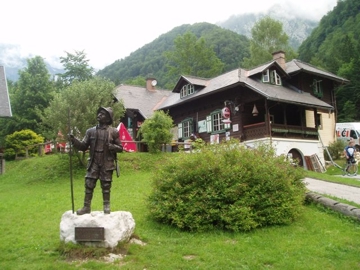
The Cankar Memorial House on Klanec in Vrhnika is a precious cultural monument in the middle of the Vrhnika town centre. It is located on the spot where once stood a wooden, straw-thatched cottage in which the writer Ivan Cankar was born. Today, under the guidance of a guide, a collection of objects is on display which shows the living conditions of a poorer family at the end of the 18th and at the beginning of the 19th century. On the shelves and in the display cases Cankar's first editions are exhibited, photographs of the writer, of his relatives, friends and benefactors from the Ljubljana and Vienna periods, and his self-portraits and drawings.
Besides the Cankar memorial house and the monument, this market town has several other interesting historical buildings and monuments.