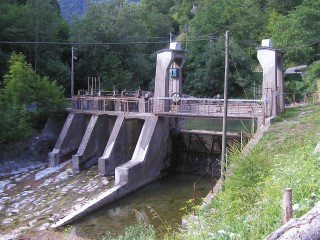
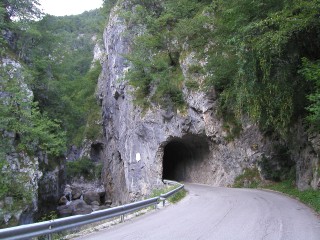
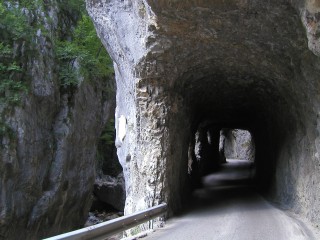
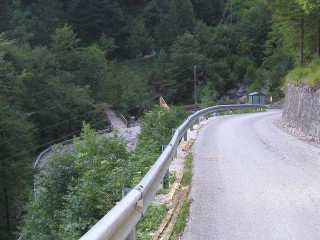
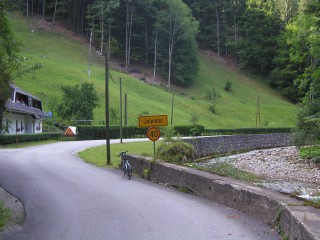
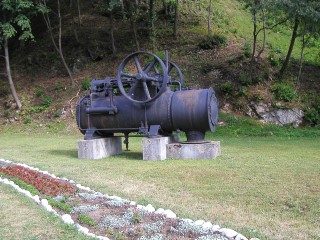
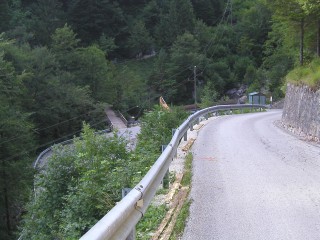
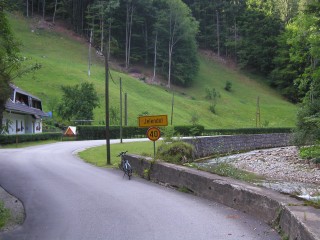
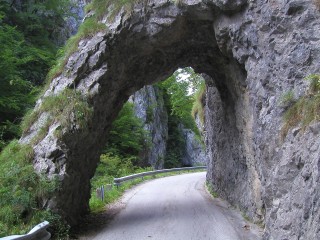
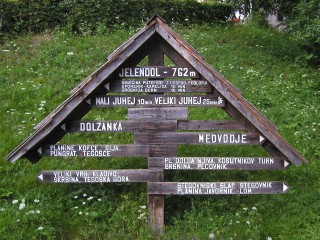
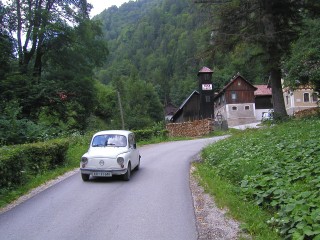
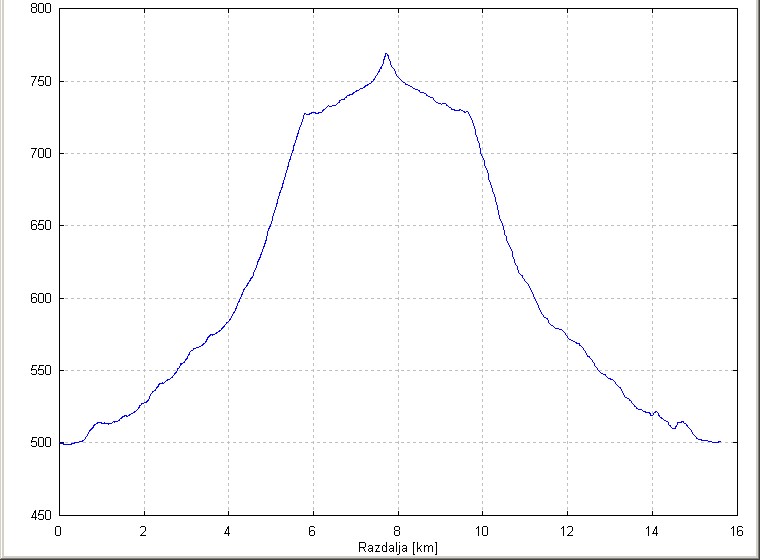
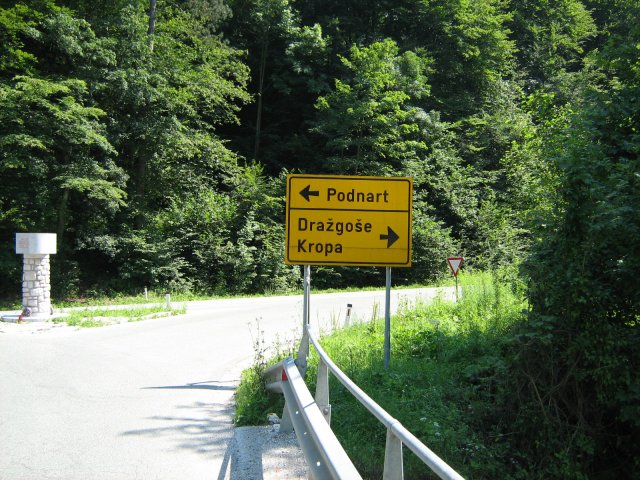
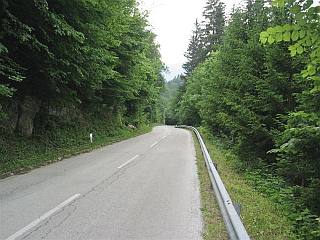
We start the route at the beginning of Tržič. Along the main priority road through Tržič to the village of Čadovlje. In this village we can also see the drying house »Paštba« , which they used for drying flax, fruit… and which is the only one preserved in Slovenia. Through the village of Čadovlje we cycle into the Dolžanka gorge. Through the narrows and the stone tunnel the climb to the village of Doline begins. The cascade below the village of Dolina is a rare example of a cascade in Slovenia, about 300 metres long. On it there are numerous chutes and rapids and small waterfalls 5 metres high. The asphalt ends in the village of Jelendol by the Puterhof manor (Puterhof is today's name of the place Jelendol.) where we turn round. The old path from the Dolžanka gorge leads us through a smaller tunnel on the right bank of the Tržiška Bistrica. We, however, return to Tržič along the same route. At the first bridge we turn right, then straight on to the next bridge, where we again turn right and come to the old part of the town. On the square in the middle of the town we turn left, and before the bridge once more right, and continue the route along the Tržiška Bistrica to the next bridge where we cross it and return back to Tržič.
The parish church of the Annunciation of Mary stands beside the Tržič cemetery. You walk to it through the old town centre, past the church of St Andrew, along Partizanska ulica and then past the Kurnik house along Cerkvena ulica. The single-nave church with two chapels and a dome was designed in 1808 on the foundations of a Gothic church from the 16th century. The dome and the walls are adorned by Layer's frescoes. The Mally house stands at the beginning of the main street in the old town centre. It belongs to the group of burgher-noble mansions, and the Renaissance portal with the date 1618 shows the rich late Gothic and Renaissance period of the town. A ribbed vault from the 17th century is preserved on the ground floor and the upper floor. Characteristic are the wrought-iron doors (safety against fires) , the open roof structure (drying openings for drying hides) and the Classicist façade from the beginning of the 16th century. At the entrance to the town, opposite the Pr`Slug inn, you set off on a shorter walk which after approximately 10 minutes brings you to the top of the hill, where the church of St Joseph stands and from where a beautiful view of the old town centre of Tržič opens up to you. The Upper Cottage, in which the Tržič Museum also has its premises, is located in the old town centre of Tržič. An example of a rich mansion from Classicism, while its exterior recalls the characteristic way of building in the town after the severe fire of 1811 – an articulated façade with wrought-iron shutters, on the roof there are drying openings , where flax was dried. On the first floor is the living part, on the second the representative part, in which an ornamentally and figurally painted burgher salon from the middle of the 19.century stands out. The birth house of the Tržič poet Vojteh Kurnik stands on the other side of the upper bridge over the Tržiška Bistrica. The building represents burgher – craft architecture from the 18th century. The first floor is adorned by a long wooden balcony – a gang. The building is one of the few , which is still covered with wooden shingles – šinklni or skodla. On the roof drying openings are noticeable , which were intended for drying stockings. The doors and windows , walled with stone frames of green Peraš stone, are small, as are the vaults inside. In this way they saved a little on energy. Inside the house there is a black kitchen, a chamber, a small room – a štibelc, where a memorial room is arranged, and a living space called the ‘house’. In the ‘house’ the former shoemaking workshop is shown.Neuhaus Castle stands on a rise above the town centre. It most probably came into being with the new settlement and represented the seat of authority over the upper part of Tržič. The castle changed owners several times. The Dev house is the birthplace of Anton Feliks Dev – religious name Janez Damascen Dev (1732 – 1786). In 1779 he published the first almanac of Slovenian poems – Pisanice, which means that besides being editor and publisher he was also the founder of Slovenian secular poetry. He also wrote the first Slovenian libretto – the text for an opera – Belin.
In the village of Čadovlje you can see the »Paštbo« drying house , which was used for drying flax, fruit… and is the only one preserved in Slovenia.
The Dovžan gorge is protected as a natural monument because of its unique site of Palaeozoic rocks and is at the same time one of the central points of the Slovenian geological trail.
Fossils are the remains of the former life of plants and animals which have been preserved in the walls to the present day. Tectonic forces and the destructive power of the Tržiška Bistrica have over millennia shaped a wonderful gorge, which the Tržiška Bistrica carved into black limestone, laid bare a varied rock base and made possible the growth of numerous plant communities. The valley of the Tržiška Bistrica is squeezed between the steep walls of rock pyramids, called the Kušpegar pillars in the east and Borova peč in the west. From Borova peč large rock blocks of quartz conglomerate have crumbled away in the past, which came to rest in the riverbed. And it is precisely on them that the Tržiška Bistrica is shows all its strength; in chutes, small waterfalls and rapids it forces its way over the rounded rocks. Even in the last century the river shaped the fate of the locals; their eternal problem was bringing timber and charcoal down into the valley, since they had to force their way through the forest and over the steep surrounding hills.