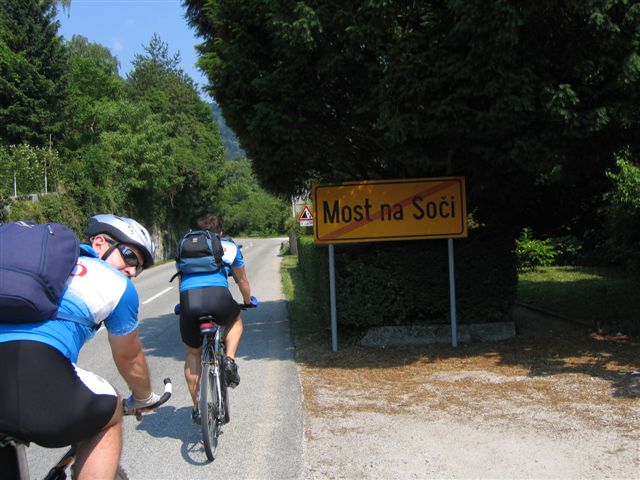
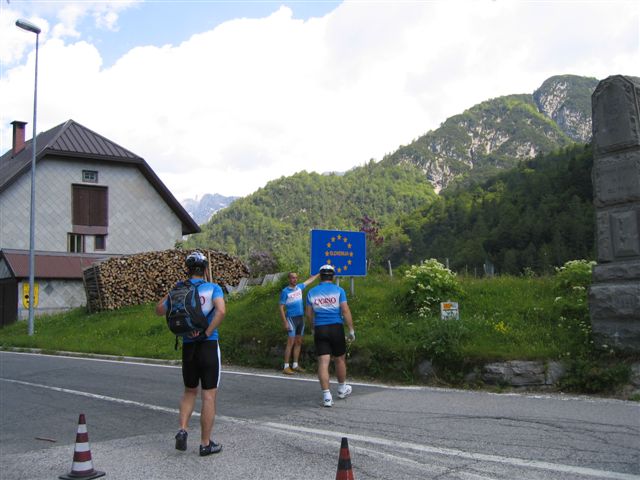
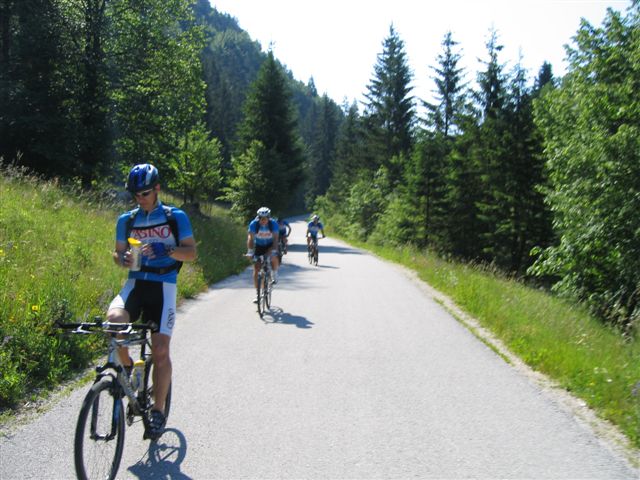
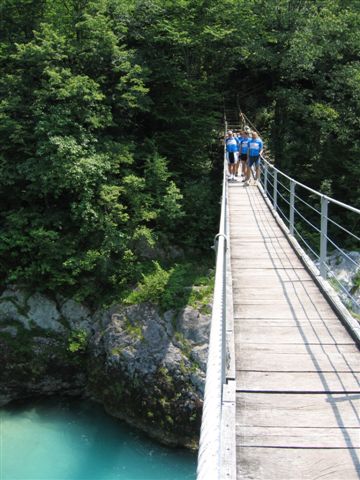
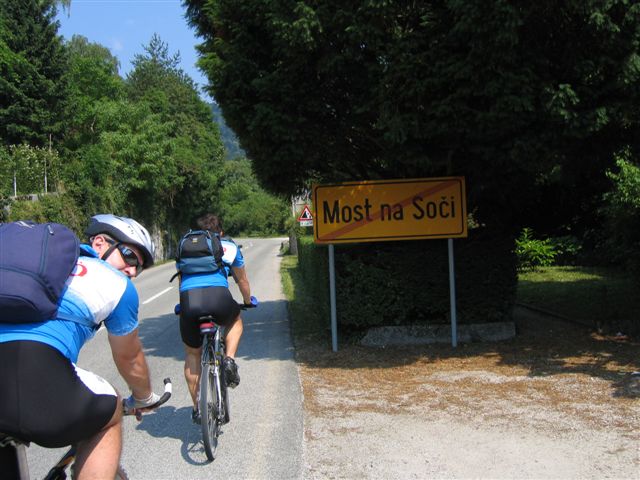
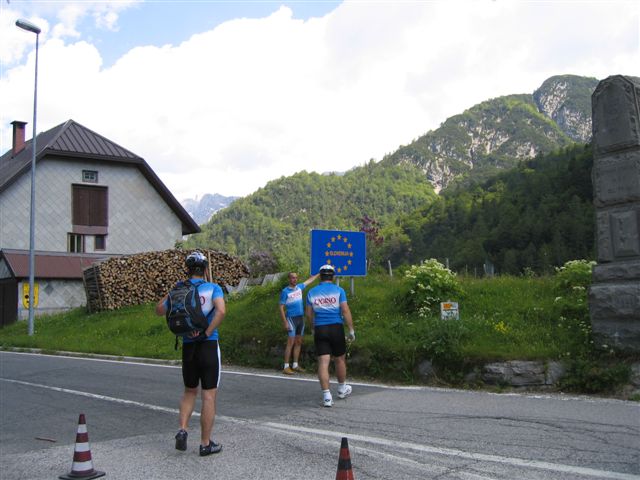
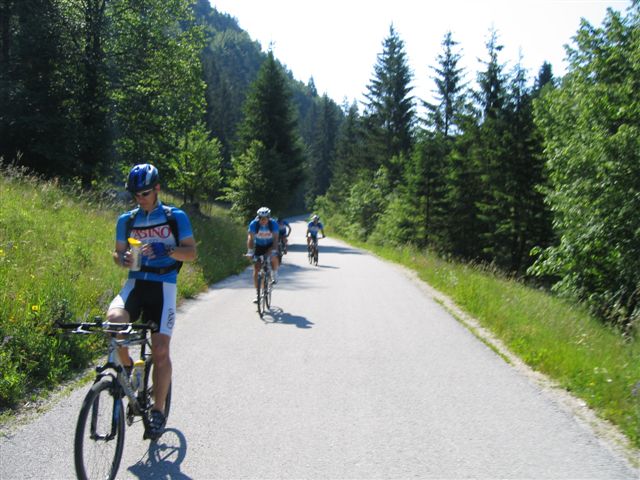
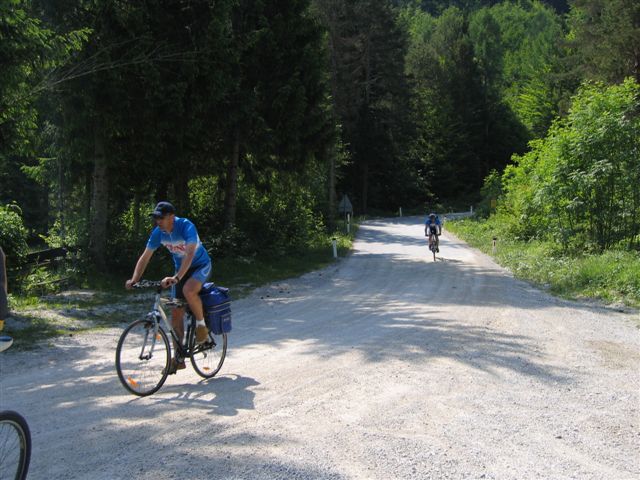
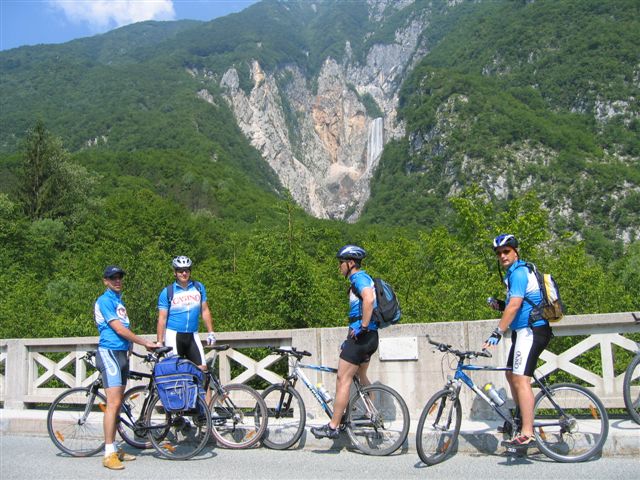
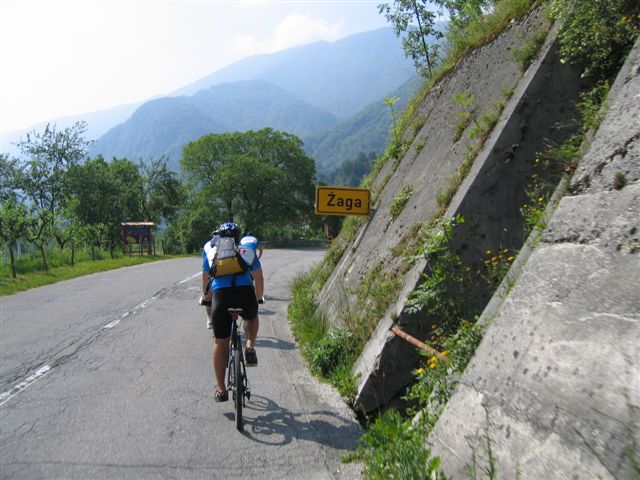
The start in Bovec was followed by a few kilometres' (3km) descent to the Boka torrent, and then around Polovnik past Žaga and Srpenica towards Kobarid (approx. 20km).After a short stop in Kobarid we descended across the Soča to the footpath into the valley of the Kozjak waterfall (approx. 15 min on foot one way). After a good hour we continued with the bicycles towards Tolmin and Most na Soči.
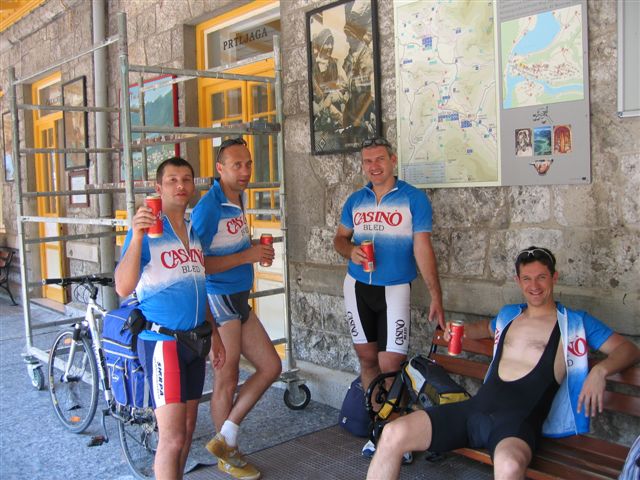
This last part of the route (approx. 30km) recalled a time trial more than an outing, because we were all in a hurry for a well-earned beer.
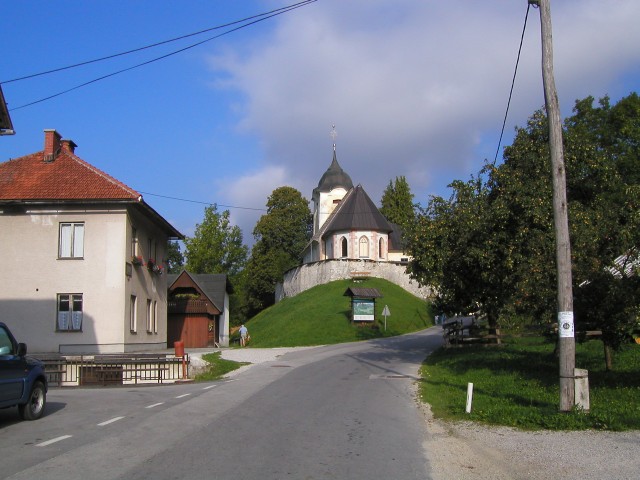
The church of St Ulrich, with its dominant position on a high plateau, to which a monumental staircase leads, gives Bovec a more picturesque appearance. The main façade is designed in Neo-Romanesque style, and in the nave of the church we find remains of the old Gothic building, whose traces are visible in the Gothic portals and in the Gothic chancel arch in the eastern wall of the nave. In the interior of the presbytery is a mighty altar, made of local reddish stone. To the rich and varied interior additional charm is given by windows with images of multicoloured glass, while the exterior appearance is completed by a mighty bell tower.
The Kluže fortress is 4 km from Bovec in the direction of the Predel pass. In the second half of the 15th century a wooden fortification was built above the deep gorge of the river Koritnica, which was to prevent Turkish raiding expeditions into Carinthia. Georg Philipp von Gera, governor of Bovec in the years 1613 – 1643, erected a stone fortress in 1613 and discovered a spring nearby, which enabled the garrison to withstand even longer sieges. Into the wall by the fortress he had built an exceptionally finely worked stone slab with his coat of arms and the year of building.The fortress acquired its present appearance in 1882.
The Great Kozjak waterfall is one of the loveliest waterfalls in Slovenia. From all sides it is surrounded by walls, so that it looks as if it were falling into a great hollow. Below the waterfall there is also a smaller pool.
In Tolmin you can stop on the way at the Tolmin Museum, where you can see the permanent exhibition Alluvia of Soča history. You can likewise see the Tolmin gorges, which are the lowest entry point into the Triglav National Park. They are a natural monument, created by the river Tolminka.
Most na Soči is a compact roadside settlement in the Upper Soča valley. It lies at the southern end of the Tolmin basin in the north-western part of Slovenia. In the settlement stands the church of St Maurus, first mentioned in written sources as early as 1192. At Most we find restored and protected remains of a Roman house. Interesting is the monument to the soldiers of the 1st World War at Postaja. The birth house of Ciril Kosmač is included in the European programme Genius loci, which links the birthplaces of famous creators – Giotto, Goya, Lorca, Novalis and Kosmač. The main attraction of Most na Soči is the lake. The town also has many opportunities for excursions and tours.
The asphalt trunk road from Bovec towards Nova Gorica, in the main a constant easy descent-recommended for road bicycles.